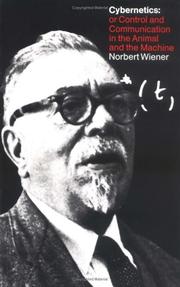
Cybernetics
Control and communication in animals and machines run on the same principles.
Summary
Wiener, a mathematician at MIT, published this in 1948 and created a field. The subtitle states its scope: control and communication in the animal and the machine.
The unifying claim is that control and communication in machines, in living organisms and in social organisations obey the same mathematical principles, and that these principles centre on feedback. A system that measures the difference between its actual state and a target and acts to reduce that difference is performing the same operation whether it is a thermostat, a servomechanism aiming a gun, a person reaching for an object, or an organisation adjusting to conditions. Wiener developed this from wartime work on anti-aircraft fire control, where the problem was predicting an aircraft's future position from its observed track.
The technical content covers time series and prediction, the statistical filtering that bears his name, the treatment of information as a measurable quantity related to entropy, developed alongside Shannon's work, the mathematics of feedback and the conditions under which a feedback system becomes unstable and oscillates, and the analogy between nervous systems and computing machines.
Wiener also drew social conclusions. He argued that automation would displace routine human labour on a large scale and that societies should prepare for it, and he warned against applying the machinery to human beings without regard for consequences. He wrote about this at more length in The Human Use of Human Beings.
The book is mathematically demanding and the exposition is disorganised, moving between rigorous derivation and speculation. Cybernetics as a named field faded, with its contributions absorbed into control theory, information theory, computer science, systems biology and management science. The framework's influence is greater than its current visibility, and the treatment of feedback and instability remains directly applicable.
Key takeaways 7
- Control in machines, organisms and organisations follows the same mathematical principles centred on feedback.
- A system that measures the difference between its state and a target and acts to reduce it performs the same operation regardless of what it is made of.
- Feedback systems become unstable and oscillate when the correction is too large or arrives too late.
- Information can be treated as a measurable quantity related to entropy rather than as an informal concept.
- Prediction from a noisy observed signal is a statistical filtering problem with a determinate optimal solution.
- Automation would displace routine human labour on a large scale, which Wiener argued in 1948 that societies should prepare for.
- The analogy between nervous systems and computing machines is structural rather than metaphorical, because both process signals through switching elements.
Who should read it
Readers who want the origin of feedback and control thinking, which underlies systems analysis in engineering, biology, economics and management.
Similar books 6
Chosen by shared topics, the entries that hold them, and the people who recommended both.

How a mind could arise from parts, traced through Godel, Escher and Bach.
Recommended by: Nat Eliason, Naval Ravikant, Demis Hassabis and 3 others

How a honeybee colony allocates its foragers, as a decentralised system.
“As Thomas Seeley writes in his delightful book, The Wisdom of the Hive: 22 The most thought-provoking feature of a honey bee colony is its ability to achieve coordinated activity among tens of thousands of bees without central control.” — Michael Mauboussin
Source: Capital Ideas Revisited: The Prime Directive, Sharks, and The Wisdom of Crowds, page 7
Recommended by: Michael Mauboussin
Computer tools that help people, even children, explore how complex systems work.
“The first challenge to the centralized mindset comes from a delightful book by MIT Professor Mitchel Resnick, “Turtles, Termites, and Traffic Jams.” — Michael Mauboussin
Source: The Invisible Lead Steer: New Answers to Old Questions About the Stock Market, page 3
Recommended by: Michael Mauboussin
Self-organised criticality: why earthquakes and crashes come in all sizes.
“Mark Buchanan, Ubiquity: The Science of History . . . Or Why the World is Simpler Than We Think (New York: Crown Publishers, 2000)” — Michael Mauboussin
Source: Interdisciplinary Perspectives on Risk, page 5
Recommended by: Michael Mauboussin

How very simple programs produce complexity, and what that explains in nature.
Recommended by: Mohnish Pabrai, Steve Jurvetson
Five disciplines, led by systems thinking, that let an organisation learn.
Recommended by: Jim Collins, Mohnish Pabrai, Sahil Lavingia and 1 other
Where it sits in the reference 2
Topics 6
As an Amazon Associate I earn from qualifying purchases.