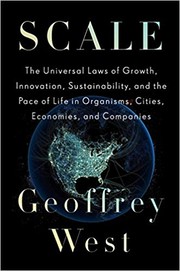
Scale
Why organisms, cities and companies follow power laws set by their supply networks.
Summary
West, a theoretical physicist at the Santa Fe Institute, argues that biological organisms, cities and companies all follow power-law scaling relationships, and that these relationships have quantitative explanations in the geometry of the networks that supply them.
The biological finding is that metabolic rate scales as roughly the three-quarter power of body mass across many orders of magnitude, which means larger organisms are more energy-efficient per unit mass. West explains this through the geometry of space-filling fractal distribution networks including circulatory and respiratory systems, and shows that the same exponent predicts lifespan, heart rate and other characteristics.
The urban finding is that infrastructure in cities scales sublinearly at about 0.85, so a city twice the size needs less than twice the roads and cables, while socioeconomic output including wages, patents, crime and disease scales superlinearly at about 1.15, so doubling the size produces more than double the output per capita. West argues this superlinear scaling drives urbanisation and also produces accelerating cycles of innovation, because superlinear growth reaches a singularity that only a new innovation can reset.
The company finding is that firms scale sublinearly like organisms rather than superlinearly like cities, which West connects to their finite lifespans. He reports that the mortality distribution of companies resembles that of organisms and that most public companies die within a few decades. Critics argue that the scaling exponents depend heavily on how cities and firms are defined, that correlation across aggregates does not establish the network mechanism, and that the biological three-quarter exponent is itself disputed. The scaling framework is genuinely useful and the causal explanations are less established than West presents them.
Key takeaways 8
- Biological metabolic rate scales as approximately the three-quarter power of mass, which means larger organisms use less energy per unit of mass.
- City infrastructure scales sublinearly at about 0.85, so larger cities require proportionally less physical infrastructure per person.
- Socioeconomic output in cities scales superlinearly at about 1.15, so doubling a city's size produces more than double its wages, patents and crime.
- Superlinear scaling produces accelerating growth that reaches a limit, which requires a new innovation to reset the cycle, and the interval between resets shortens.
- Companies scale sublinearly like organisms rather than superlinearly like cities, which West connects to their finite lifespans.
- Most public companies die within a few decades, and their mortality distribution resembles that of biological organisms.
- Cities almost never die, which West attributes to the difference between their superlinear social dynamics and the sublinear economies of firms.
- The causal explanation through network geometry is more contested than the scaling relationships themselves, which are better established.
Who should read it
Investors and operators interested in quantitative regularities across biology, cities and firms, treating the causal mechanism as less settled than the data.
Who recommended it 6 · 4 direct
“Geoffrey West, Scale: The Universal Laws of Growth, Innovation, Sustainability, and the Pace of Life in Organisms, Cities, Economies, and Companies (New York: Penguin Press, 2017), 26”
“Geoffrey West did a talk version of his book Scale, which is particularly fantastic.”
Similar books 6
Chosen by shared topics, the entries that hold them, and the people who recommended both.

Network science on how success and reputation build up unequally.
“This book transforms how our success-obsessed society approaches their professional careers and long-term goals.” — Vinod Khosla
Source: 2019 Book Recommendations — Vinod Khosla, Medium
Recommended by: Vinod Khosla, Nassim Nicholas Taleb

Self-organised criticality: why earthquakes and crashes come in all sizes.
“Mark Buchanan, Ubiquity: The Science of History . . . Or Why the World is Simpler Than We Think (New York: Crown Publishers, 2000)” — Michael Mauboussin
Source: Interdisciplinary Perspectives on Risk, page 5
Recommended by: Michael Mauboussin

A graduate text on power laws, fractals and critical points in complex systems.
Recommended by: Nassim Nicholas Taleb

The science of networks, and why social networks, companies and organisms are alike.
“Barabasi, Albert-Laszlo, Linked: How Everything is Connected to Everything Else and What It Means (New York: Perseus Books, 2002)” — Michael Mauboussin
Source: Exploring Network Economics, page 15
Recommended by: Michael Mauboussin, Mohnish Pabrai

How mathematics and physical forces shape the forms of living things.
Why body size matters in living things.
“John Tyler Bonner, Why Size Matters (Princeton, NJ: Princeton University Press, 2006)” — Michael Mauboussin
Source: Importance of Diverse Thinking: Why the Santa Fe Institute Can Make You a Better Investor, page 10
Recommended by: Michael Mauboussin
Where it sits in the reference 3
Topics 4
As an Amazon Associate I earn from qualifying purchases.