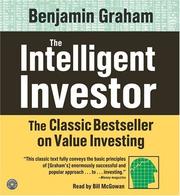
The Intelligent Investor
Treat stocks as parts of businesses and buy only with a margin of safety.
Revised through the 1973 fourth edition; 2003 Jason Zweig commentary edition.
Summary
Graham distinguishes investment from speculation and gives the defensive investor a set of rules that require no forecasting skill. An investment operation, in his definition, promises safety of principal and an adequate return on thorough analysis, and anything else is speculation. The book divides readers into defensive investors, who should hold a mechanical split between high-grade bonds and diversified large-cap stocks between twenty-five and seventy-five percent each, and enterprising investors, who may do more work in search of bargains.
Two ideas carry most of the weight. Mr Market is Graham's device for describing price quotations as offers from a manic-depressive partner, useful when he is irrational and ignorable otherwise. Margin of safety is the requirement that the purchase price sit far enough below appraised value that error and bad luck do not destroy capital. Graham applies both through explicit numerical criteria for earnings stability, dividend record, price to earnings and price to book.
Zweig's 2003 commentary sits after each chapter and does much of the practical work for a modern reader. He updates the examples to the dot-com bubble, converts Graham's specific screens into current terms, and argues for index funds as the default implementation of Graham's defensive strategy, which Graham himself moved toward late in life.
Much of Graham's own text is dated. His examples come from the 1930s to the early 1970s, the accounting conventions have changed, and quantitative screens of the type he specifies now find far fewer securities in developed markets. Book value means less in an economy dominated by intangible assets. Read chapters 8 and 20 on market fluctuations and margin of safety as the enduring core, and read the security selection chapters as historical method.
Key takeaways 8
- An investment operation must promise safety of principal and an adequate return on thorough analysis, and everything failing that test is speculation.
- The investor's chief problem, and worst enemy, is himself, because temperament determines results more than analysis does.
- Price quotations exist to serve the investor, not to inform him, so market prices should be used only when they offer an attractive transaction.
- Every purchase requires a margin of safety, meaning a price far enough below appraised value to absorb analytical error and bad luck.
- A defensive investor should hold a fixed allocation between high-grade bonds and diversified stocks and rebalance mechanically rather than forecast.
- Buying growth at high multiples exposes an investor to disappointment because the expected growth is already in the price and often fails to appear.
- Past performance of a security or fund provides almost no basis for expecting future performance.
- Most investors should accept market returns through a diversified low-cost holding rather than attempt an enterprising strategy they will not sustain.
Who should read it
Investors who want the origin of value investing in the author's own words, best read with Zweig's commentary and with the screening chapters treated as history.
About Benjamin Graham
Co-founder, Graham-Newman Corporation; lecturer in finance, Columbia Business School 1928-1956
Security Analysis and The Intelligent Investor are the founding texts of value investing and remain the primary source every later value investor argues from.
Who recommended it 34 · 23 direct
“Although I’ve been reading The Intelligent Investor on a regular basis over the years, I never reread the 1958 speech, until I came across a Latin quote from Ben Graham and searched far and wide for its origin.”
“In The Intelligent Investor, Ben Graham described the stock market as a weighing machine in the long run but a voting machine in the short run.”
“Originally published in 1949, called by Warren Buffett "by far the best book on investing ever written," this handbook covers far more than just how to determine how much a company's stock is worth.”
“everyone has to read Intelligent Investor, you know I think it's chapters 8 and 20”
“I’d studied his wonderful book The Intelligent Investor, published in 1949, and decided to see what I could discover.”
“As Graham states on Page 103 of the 1973 edition of The Intelligent Investor, we are led “to a conclusion of practical importance to the conservative investor in common stocks. If he is to pay some special attention to the selection of his portfolio, it might be best for him to concentrate on issues selling at reasonably close approximations to their tangible-asset value–say, at not more than one third above that figure.”
“Benjamin Graham, The Intelligent Investor, 4th ed. (New York: Harper & Row, 1973), 277-287”
“Wonderful Book. There is a lot of terrific data in this book. Needs to be read slowly and carefully - and then re-read. Strongly recommended.”
“Benjamin Graham's The Intelligent Investor is a phenomenal book as well. And I really enjoy that one and would recommend that to your listeners as well.”
“As Ben Graham, dean of security analysts, stated a long time ago in his book ‘‘The Intelligent Investor,’’ ‘‘The investor with a portfolio of sound stocks should expect their prices to fluctuate and should neither be concerned by sizeable declines nor become excited by sizeable advances.”
“First, however, let me say that Graham’s The Intelligent Investor,4 which you recently revised, is probably more accessible than Graham and Dodd’s Security Analysis, 5 although the nifty thing about the sixth edition of Security Analysis is the updated comments.”
“Additionally, Jason Zweig last year did a first-class job in revising The Intelligent Investor, my favorite book on investing.”
“Bernstein Margin of Safety in the Asset-Class Era Earlier in the year, editorial duties led me to reread Benjamin Graham’s The Intelligent Investor.”
Similar books 6
Chosen by shared topics, the entries that hold them, and the people who recommended both.
How to read financial statements sceptically and value bonds and stocks.
“I am reminded once again of the quote that sits in the front of Ben Graham’s Security Analysis, from Horace’s Ars Poetica: “Many shall be restored that now are fallen and many shall fall that now are in honor.” — Bill Miller
Source: 2007 Q3 Market Commentary
Recommended by: Bill Miller, Christopher Bloomstran and 18 others
Avoid permanent loss: buy well below value and aim for absolute returns.
“Seth Klarman, the founder, chief executive, and portfolio manager of the very successful value investing firm The Baupost Group, shares a similar sentiment in his book Margin of Safety:22 It is not clear why investors suddenly came to accept EBITDA as a measure of corporate cash flow.” — Michael Mauboussin
Source: What Does an EV/EBITDA Multiple Mean?, page 4
Recommended by: Arnold Van Den Berg, Frank Martin, Guy Spier and 7 others
Columbia's value investing method: a valuation in three stages, most reliable first.
“In the book, Value Investing–From Graham to Buffett and Beyond, by Greenwald, Kahn, Sonkin and Van Biema, there are discussions of NAV.” — Martin J. Whitman
Source: Third Avenue Funds Q3 2003 Shareholder Letters (Chairman's letter by Martin J. Whitman)
Recommended by: Martin J. Whitman, Michael Mauboussin and 5 others
The memoirs of the investor who laid the foundation of security analysis.
“Those whose appetites have been whetted can proceed to The Intelligent Investor (Harper and Row) by Benjamin Graham.” — William J. Bernstein
Source: Efficient Frontier, issue 996 (1996)
Recommended by: Guy Spier, Jason Zweig, Mohnish Pabrai and 8 others
Buy a few outstanding growth companies, research them by scuttlebutt, and hold.
“In his book « Common stocks and Uncommon Profits », the legendary investor Philip Fisher devoted a complete chapter on “when to buy”.” — Francois Rochon
Source: Giverny Capital Annual Letter to Partners 2003, page 3
Recommended by: Arnold Van Den Berg, Bill Stewart and 12 others
Berkshire's shareholder letters arranged by topic: governance, valuation, mergers.
“The resource is as valuable as Larry Cunningham's The Essays of Warren Buffett, which similarly organizes by subject matter” — Christopher Bloomstran
Source: Semper Augustus 2024 Letter to Clients, 'Books and Tunes for Walking', p. 96
Recommended by: Christopher Bloomstran, Francois Rochon and 11 others
Where it sits in the reference 8
Topics 1
As an Amazon Associate I earn from qualifying purchases.