Updates

  1. Fund letters lists 118 more letters, each with its own page: 44 weekly commentaries by Jeremy Siegel from 2026, 31 issues of Van Tharp's newsletter from 2018, 23 Pabrai Investment Funds letters from 2021 to Q3 2026, 13 Efficient Frontier essays by William Bernstein, Oakmark's three 3Q 2026 commentaries, two Lindsell Train reports, a John Hussman comment and Third Point's Q3 2026 letter.
  2. 2,027 more books carry a one-line description in the Books table and on their pages; 7,067 of 7,715 have one, every tier 1, 2 and 3 book among them.
  3. Fund letters lists 187 more letters from 19 firms, among them Permanent Equity, Social Capital, Lux Capital, Square Peg, Bestinver, Cobas, Sequoia Fund, Marketfield and EquityCompass; each shows on its investor's page and has a page of its own.
  4. 2,928 more books carry a one-line description in the Books table and on their pages, so every tier 1, 2 and 3 book has one; 5,040 in all.
  5. Every publication on Newsletters has its own page: its writing, its writers, its staff and who recommends it. Investor pages have a Management tab; a company's Experts tab now leaves out its own people, who list under Management. Tabs on a phone move sideways only.
  6. Every fund letter and research paper has its own page: the thesis, the PDF, the companies and books it names, and for 176 letters and 24 papers so far a summary, key insights and quotes with their page.
  7. 99 books that no page listed now sit under their topics in Books, among them Caste, American Prometheus and Pale Blue Dot.
  8. Newsletters lists every newspaper, magazine, investment newsletter, journal and blog the reference holds, 442 in all, with the people who write there. The search box keeps your last 20 searches. You can create an account.
  9. 283 books that fund managers recommend in their letters are on the shelf, each with the letter's own words and page; investor pages have a Recommends tab.
  10. Person, company, investor and show pages link their own accounts on X, Threads, Instagram, LinkedIn, YouTube and Substack: 275 people, 552 companies and organisations, 88 investors and 478 shows.
  11. 716 more book recommendations name their source: the person's own reading list, letter, blog post, speech or interview, or an article that reports it. 232 of them quote the person's own words about the book, on the book card and on the book's page.
  12. Every US-listed company has a page with its SEC filings. Company pages list their experts and their management, past and present. Fund managers sit under Investors. Each show has a page of its episodes, and an episode page names its guests and hosts. Biographies lists groups, then people. Breadcrumbs show where a page sits.
  13. Media lists every podcast episode, video, interview and talk, over 10,000, by person, company, publisher and event; each filter searches its own choices. Books opens on its table, then Browse, then Authors and Recommenders. A filter's count no longer covers its arrow.
  14. A book that no company, country or subject page lists shows its topics under Where it sits in the reference. On a phone, a page's tabs scroll sideways only. Descriptions read the same on every page. See them in the Experts tab lists every expert the page names.
  15. Every podcast episode, video and interview has its own page with a video or audio player and a link to the source. Investor pages show each company's sector and market cap; firms such as Berkshire Hathaway have one page that holds their letters and their company tabs. Letters tabs filter by company and search the theses. Companies filter by Public, Private and Defunct and link each company's website.
  16. Every tab, view and search has its own address, such as /books/table/asset or /letters/companies, so Back works and a link opens the same place. Page addresses no longer end in .html. Fund letters, Investors, Companies and Papers load about a fifth of the data they did.
  17. Fund letters has a Companies tab: every company the letters name, with its market cap, sector, country, and how many letters and investors name it. Investor pages link each investor's website. Lists in table cells end with “… and N more” at every width.
  18. 1,120 more book summaries; descriptions for 373 papers; pages for 137 more companies, each with the fund letters that discuss it; 215 official photographs; search has its own page.
  19. 411 more books have a summary; person pages list 930 more of the books they wrote; 147 people show their official photograph.
  20. Every investor has a page with its letters and the companies they discuss; company pages list the investors whose letters name them.
  21. A Companies section at the top of the rail lists every company the books, experts and fund letters name.
  22. Person pages list letters, writing, profiles and links as sortable tables with filters, and show each person's companies as links; Fund letters show each letter's description in its own column.
  23. Experts show a checked job title and a short description of each person; 30 more people have photographs.
  24. Every company, fund, university and publication the experts work for has a page listing the people there.
  25. Fund letters show each letter's thesis and filter by it; 225 person pages list the essays, columns and newsletter issues the person wrote.
  26. Person pages list every essay and newsletter issue a person wrote, and their own books as a table in List view.
  27. Recommends shows the five largest kinds of book and the rest under More; browse pictures load sooner.
  28. Podcasts and talks link the original episode, filter by Audio and video or Press, and list each publisher once.
  29. Pages are wider, Recommends has List and Grid, and a filter clicked again turns off.
  30. Book cards sit in a ruled grid with Open Library and Goodreads links and each book's one-line note.
  31. Funds is now Investors; each investor's styles are buttons that filter the table.
  32. Podcasts and talks on a person's page filter by year and publisher and show as a list or a grid of pictures.
  33. Quotes show only people's own words: 472 summaries written by list sites are gone.
  34. Country pages open from Browse again, and every link on the shelf lands on a page.
  35. Subject and person pages show their sections as tabs, and each book appears once on a person's page.
  36. Book cards show the quote, who said it and the source; grids show five cards to a row.
  37. On a phone, a menu holds the sections, search, Updates, Feedback and dark mode.
  38. Feedback takes a screenshot of the page with no browser prompt, opens a screenshot full size when you click it, and clears itself once sent.
  39. Book cards are centred, search names the topic each book sits in, and any text cut short shows whole on hover.
  40. Search groups its results by kind: people, companies, geographies, subjects, topics, books, funds, fund letters and papers.
  41. The Books table lists who recommended each book by name, and the browser tab names the section you are in.
  42. Feedback can take a screenshot of the page, or one you paste or choose, and opens in the corner beside Updates.
  43. Each rail button reopens its section where you left it, and Browse, Table and People show on every book and subject page.
  44. Filters grey out choices that hold nothing instead of hiding them, and Books › People filters by authors or recommenders.
  45. Feedback takes a subject line and up to three screenshots.
  46. Biographies are grouped by the person they are about: 41 new pages, from Abraham Lincoln to Lee Kuan Yew.
  47. Sport splits into 23 sports, and Religion into one topic per faith.
  48. Book lists show as cards: the cover, one recommendation quote and every recommender by name.
  49. Seventeen subjects that had two or three pages under different names now have one page each.
  50. Every page lists its Experts as authors and recommenders, with a link to them on the Experts tab.
  51. Economics, Financial history, Financial panics and Accounting are subjects of their own, with one page per financial crisis.
  52. Book, person and subject pages open inside the app, so the tabs stay in view.
  53. 996 more book covers, and photographs or logos for 227 more people and companies.
  54. Books › Browse shows every subject as cards, and the rail holds Fund letters, Papers, Experts, Books and Funds.
  55. Every topic over 150 books splits into narrower topics, each with a page of its own.

Send feedback

What is it?
Screenshots, up to 3 (optional)
or paste one with Ctrl+V

We use your email only to reply to you.

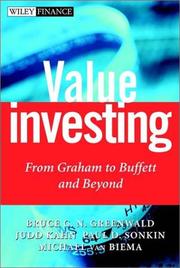
Value Investing: From Graham to Buffett and

Value Investing: From Graham to Buffett and Beyond

Columbia's value investing method: a valuation in three stages, most reliable first.

Bruce Greenwald, Judd Kahn, Paul D. Sonkin, Michael van Biema
2001
T3 316 pages · about 5h 16m to read Open Librarygoodreads

Wiley published it in 2020.

Summary

Greenwald taught value investing at Columbia and this book states the analytical framework he developed there. Its main contribution is a three-stage valuation sequence ordered by reliability of the inputs rather than by theoretical completeness.

The first stage is asset value, calculated as the reproduction cost of the assets a competitor would need to enter the business, which Greenwald argues is more reliable than book value and more relevant than liquidation value for a going concern. The second is earnings power value, calculated as sustainable current earnings divided by the cost of capital, with adjustments to normalise for the cycle and for maintenance capital expenditure. He is explicit that this stage assumes no growth, deliberately, because growth assumptions are the least reliable input available.

The comparison between the two stages is the analytical core. If earnings power value substantially exceeds asset value, the business has a competitive advantage and the difference measures it. If asset value exceeds earnings power value, management is destroying value or the industry has excess capacity. Only where a franchise exists does Greenwald allow growth to be valued at all, because growth in a competitive business earns only the cost of capital and therefore adds nothing.

The second half profiles practitioners including Buffett, Michael Price, Walter Schloss, Mario Gabelli, Glenn Greenberg, Robert Heilbrunn, Seth Klarman and Paul Sonkin, with their methods described. The method requires detailed work and the examples in the book are dated. The reproduction cost calculation is difficult for intangible-heavy businesses, which is most of the modern market. Greenwald's argument that growth is only valuable inside a franchise is the most important claim and the one that distinguishes this from general valuation texts.

Key takeaways 8

  1. Valuation should proceed from the most reliable inputs to the least, starting with assets, then earnings power, and only then growth.
  2. Asset value should be measured as the reproduction cost a competitor would face to enter, not as book value or as liquidation value.
  3. Earnings power value uses sustainable current earnings divided by cost of capital and deliberately assumes no growth, because growth assumptions are the least reliable input.
  4. The gap between earnings power value and asset value measures the size of a company's competitive advantage.
  5. Growth in a business without a competitive advantage earns only the cost of capital and therefore creates no value.
  6. Growth is worth paying for only where a franchise exists that prevents competitors from earning away the returns.
  7. Asset value exceeding earnings power value indicates either management destroying value or industry-wide excess capacity.
  8. Competitive advantage comes from customer captivity, cost advantages or economies of scale in a defined market, and everything else erodes.

Who should read it

Investors who want a disciplined valuation sequence and a method for measuring competitive advantage from the financial statements.

About Bruce Greenwald

Robert Heilbrunn Professor Emeritus of Finance and Asset Management, Columbia Business School; former director of the Heilbrunn Center for Graham and Dodd Investing

Value Investing: From Graham to Buffett and Beyond is the canonical modern restatement of the Columbia value framework, and Competition Demystified is its standard companion on barriers to entry.

Who recommended it 6 · 4 direct

“In the book, Value Investing–From Graham to Buffett and Beyond, by Greenwald, Kahn, Sonkin and Van Biema, there are discussions of NAV.”

“Bruce C. N. Greenwald, Judd Kahn, Paul D. Sonkin, and Michael van Biema, Value Investing: From Graham to Buffett and Beyond (New York: John Wiley & Sons, 2001), 71-74”

“George has also written a book on value investing, From Theory to Practice, which I highly recommend.”

Similar books 6

Chosen by shared topics, the entries that hold them, and the people who recommended both.
Benjamin Graham, David L. Dodd · 1934

How to read financial statements sceptically and value bonds and stocks.

“I am reminded once again of the quote that sits in the front of Ben Graham’s Security Analysis, from Horace’s Ars Poetica: “Many shall be restored that now are fallen and many shall fall that now are in honor.” — Bill Miller

Source: 2007 Q3 Market Commentary

Recommended by: Bill Miller, Christopher Bloomstran and 16 others
Benjamin Graham, Jason Zweig · 1949

Treat stocks as parts of businesses and buy only with a margin of safety.

“Although I’ve been reading The Intelligent Investor on a regular basis over the years, I never reread the 1958 speech, until I came across a Latin quote from Ben Graham and searched far and wide for its origin.” — Francois Rochon

Source: Giverny Capital Annual Letter to Partners 2018, page 9

Recommended by: Benjamin Graham, Christopher Bloomstran and 31 others
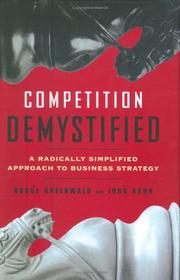
Bruce Greenwald, Judd Kahn · 2005

Why barriers to entry are the one force that matters in business strategy.

“Bruce Greenwald and Judd Kahn, Competition Demystified: A Radically Simplified Approach to Business Strategy (New York: Portfolio, 2005), 52-76” — Michael Mauboussin

Source: New Business Boom and Bust: How Capitalism Experiments, page 9

Recommended by: Li Lu, Michael Mauboussin, Mohnish Pabrai
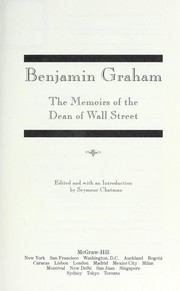
Benjamin Graham · 1996

The memoirs of the investor who laid the foundation of security analysis.

“Those whose appetites have been whetted can proceed to The Intelligent Investor (Harper and Row) by Benjamin Graham.” — William J. Bernstein

Source: Efficient Frontier, issue 996 (1996)

Recommended by: Mohnish Pabrai, William J. Bernstein

Tobias E. Carlisle · 2014

The evidence that buying cheap, troubled companies beats more refined methods.

Pat Dorsey · 2008

How to spot a durable economic moat from public information, and what isn't one.

Recommended by: Mohnish Pabrai

Where it sits in the reference 7

Academics
Academics
Biographies
Investment philosophy
Investment styles
Investment styles
Mental models

Topics 1

Investing

As an Amazon Associate I earn from qualifying purchases.