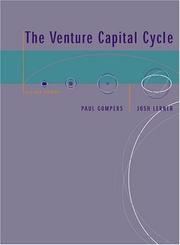
The Venture Capital Cycle
How venture funds raise, invest and exit, and what the data show about their returns.
The empirical work that established how venture returns and cycles behave.
Summary
Paul Gompers and Josh Lerner wrote the standard academic treatment of venture capital, organised around what they call the cycle: raising a fund, investing it, and exiting the investments to return capital, after which the cycle repeats.
The fundraising material covers the limited partnership structure and why it dominates, the compensation arrangement of management fee and carried interest and what each incentivises, the covenants limited partners impose and what they reveal about the agency problems they anticipate, and the determinants of fundraising success. Gompers's work on grandstanding, in which young firms take companies public earlier than optimal in order to establish a record for their next fund, is here.
The investing material covers staged financing, in which capital is committed in tranches contingent on milestones, and why this is the central control mechanism; syndication and its several possible motives; board representation and the allocation of control rights through preferred stock terms; and the specialisation of firms by stage and sector. The exit material covers the initial public offering and its timing, the relationship with underwriters, the lock-up, and acquisition as the more common outcome. The book is empirical throughout, based on the authors' research programme, and it is where the quantitative findings about venture capital originate. It predates the growth of very large funds, the extension of private company lifetimes and the current market structure, so the institutional description is dated while the analytical framework is not.
Key takeaways 7
- Staged financing contingent on milestones is venture capital's central control mechanism over portfolio companies.
- The limited partnership structure with fixed life forces distribution of capital, which disciplines the manager in ways an evergreen vehicle does not.
- Management fees and carried interest incentivise different behaviour, and firms raising larger funds shift toward fee income.
- Young venture firms take portfolio companies public earlier than optimal in order to establish a record before raising their next fund.
- Limited partner covenants reveal which agency problems investors actually anticipate, and their content changes with market conditions.
- Preferred stock terms allocate control rights separately from economic rights, which is what makes staged investment enforceable.
- Acquisition rather than public offering is the more common exit, and its economics differ substantially for the investor.
Who should read it
Venture investors, founders and researchers who want the empirical academic foundation for how venture funds are structured and behave.
Who recommended it 1 · 1 direct
“Gompers, Paul, and Josh Lerner, The Venture Capital Cycle, Second Edition (Cambridge, MA: MIT Press, 2004)”
Similar books 6
Chosen by shared topics, the entries that hold them, and the people who recommended both.
How companies go public, and the direct listings and SPACs that challenge the IPO.
Venture capital as finance: valuing startups, reading terms and expected returns.
Venture financing term by term, for founders negotiating their first rounds.
Recommended by: Patrick Collison, Brad Feld, Gaby Goldberg and 4 others
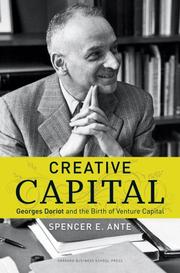
Georges Doriot, who showed that investing in small, risky firms could pay.
“For a biography of Georges Doriot, see Spencer E. Ante, Creative Capital: Georges Doriot and the Birth of Venture Capital (Boston, MA: Harvard Business Press, 2008)” — Michael Mauboussin
Source: Public to Private Equity in the United States: A Long-Term Look, page 63
Recommended by: Michael Mauboussin, Patrick Collison
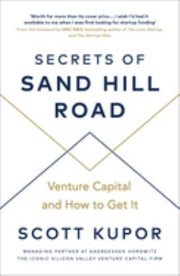
How venture capital works, from fund economics to term sheets, for founders.
Recommended by: Benedict Evans, Eric Schmidt, Gaby Goldberg and 3 others
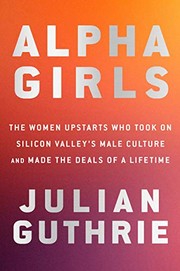
Four women who became venture capitalists in male-dominated Silicon Valley.
Recommended by: Melinda Gates, Reid Hoffman