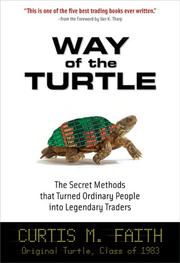
Way of the Turtle: The Secret Methods that Turned Ordinary People into Legendary Traders
A Turtle trader's account of the rules taught to novices, and why most failed.
An actual Turtle's account of the rules and why most trainees failed.
Summary
Faith was one of the traders recruited in 1983 when Richard Dennis bet William Eckhardt that trading could be taught to novices. Dennis trained two groups over two weeks, gave them capital, and the experiment became known as the Turtles. Faith wrote this account of the rules and the reasoning behind them after the original agreement not to disclose them had expired.
The method is trend following on futures. Entry is on a breakout, meaning a price exceeding the highest high of a defined lookback period. Exit is on an opposite breakout of a shorter period, or on a stop placed at a multiple of recent volatility. Position size is set so that a one-unit adverse move in volatility terms costs a fixed small percentage of equity, which means positions in volatile markets are smaller. Faith presents the volatility measure, which the Turtles called N and which is close to average true range, as the central innovation, because it normalises risk across markets with different characteristics. Diversification across many uncorrelated futures markets supplies the rest.
The conceptual arguments matter more than the parameters. Faith argues that the method produces losses on the large majority of trades and makes its money on a small number of large trends, that this distribution is psychologically intolerable for most people, and that the Turtles who failed did so by not following the rules rather than by having worse rules. He also covers expectancy, drawdown, risk of ruin, and the ways backtests mislead through survivorship bias and overfitting.
The published rules have been public for years and simple breakout systems have performed poorly since, which is the obvious objection: a mechanical system disclosed to everyone loses its edge. Faith's account of his own trading record has also been disputed by other participants. The value now is in the risk management and position sizing framework rather than in the entry signals.
Key takeaways 7
- Position size should be set from recent volatility so that equivalent risk is taken in every market regardless of its price behaviour.
- A trend following system loses money on most individual trades and earns its return from a small number of large moves.
- Traders fail by deviating from a system during drawdowns rather than by using a system with insufficient edge.
- Expectancy, meaning average gain per trade across wins and losses, is the correct measure of a system rather than win rate.
- Diversification across many uncorrelated markets is what makes a low-win-rate system survivable.
- Backtested results are systematically optimistic because of overfitting and survivorship in the instrument selection.
- Trading rules can be taught to novices in weeks, which means the edge is in execution discipline rather than in secret knowledge.
Who should read it
Traders and risk takers who want an explicit framework for volatility-based position sizing and for surviving strategies with low win rates.
Who recommended it 2 · 2 direct
“Curtis M. Faith, Way of the Turtle: The Secret Methods that Turned Ordinary People into Legendary Traders (New York: McGraw-Hill, 2007), 44”
Similar books 6
Chosen by shared topics, the entries that hold them, and the people who recommended both.
Why standard machine learning fails on market data, and how to avoid false backtests.
Market microstructure, execution algorithms and direct market access, explained.
How quantitative trading strategies are built, explained for investors.
The evidence that buying cheap, troubled companies beats more refined methods.
Recommended by: Mohnish Pabrai, Patrick O'Shaughnessy
Using a computer program to imitate the strategies of professional money managers.
Recommended by: Mohnish Pabrai
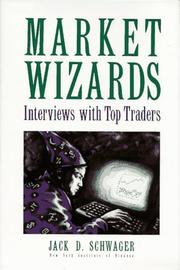
Interviews with traders such as Kovner, Dennis and Tudor Jones on their methods.
“In 1992, shortly after we had started the Oakmark Fund, I read Schwager’s first book, Market Wizards.” — Bill Nygren
Source: Bill Nygren Market Commentary | 2Q12
Recommended by: Bill Nygren, Mohnish Pabrai, Howard Marks