Advances in Financial Machine Learning
Why standard machine learning fails on market data, and how to avoid false backtests.
The standard warning about backtest overfitting, with the methods to avoid it.
Summary
Lopez de Prado, who has run quantitative research at large asset managers, wrote this to explain why standard machine learning methods fail on financial data and what has to be done differently.
His diagnosis is that financial data violates the assumptions machine learning tools depend on. Observations are not independent, the data-generating process is non-stationary, the signal to noise ratio is extremely low, and the same data set is used by thousands of researchers, which guarantees false discoveries.
The methodological contributions address these. Financial data should not be sampled by time, because information does not arrive at a constant rate; he proposes bars sampled by volume, dollar value or information content instead. Labels should be constructed by the triple barrier method, which assigns an outcome based on whether a profit target, a stop loss or a time limit is reached first, rather than by fixed-horizon returns. Meta-labelling separates the decision of whether to act from the decision of which direction to take, which allows a secondary model to filter the primary model's signals and improves precision. Fractional differentiation makes a series stationary while retaining as much memory as possible, where standard differencing destroys the information the model needs. Sample weights must account for overlapping labels, since observations sharing outcome periods are not independent. Cross-validation must use purging and embargoing to prevent information leaking from the training set into the test set across the time boundary.
His strongest general argument concerns backtest overfitting. He shows that the more strategy configurations a researcher tests, the higher the maximum backtested Sharpe ratio will be even with no real signal, derives the deflated Sharpe ratio to correct for this, and argues that most published quantitative strategies are selection artefacts.
The book is technical and assumes machine learning and statistics. It is oriented to institutional research organisations rather than to individual practitioners. The methods are prescriptions from his own practice rather than results established in the literature, and some are contested.
Key takeaways 7
- Financial observations are not independent, so standard cross-validation leaks information and produces invalid results.
- Sampling data by time is wrong because information does not arrive at a constant rate, and volume or dollar bars fit the process better.
- Labels should be assigned by whether a profit target, stop loss or time limit is reached first rather than by fixed-horizon returns.
- Meta-labelling separates whether to act from which direction to take, and lets a second model filter the first model's signals.
- Fractional differentiation makes a series stationary while retaining memory that standard differencing destroys.
- Testing many strategy configurations raises the maximum backtested Sharpe ratio even when no real signal exists.
- Most published quantitative strategies are artefacts of selection across many tested configurations rather than genuine discoveries.
Who should read it
Quantitative researchers applying machine learning to markets who need the specific methodological corrections that financial data requires.
Similar books 6
Chosen by shared topics, the entries that hold them, and the people who recommended both.
Market microstructure, execution algorithms and direct market access, explained.
How quantitative trading strategies are built, explained for investors.
A Turtle trader's account of the rules taught to novices, and why most failed.
“Curtis M. Faith, Way of the Turtle: The Secret Methods that Turned Ordinary People into Legendary Traders (New York: McGraw-Hill, 2007), 44” — Michael Mauboussin
Source: Turtles in Omaha: The Mindset of Great Investors, page 7
Recommended by: Michael Mauboussin, Mohnish Pabrai
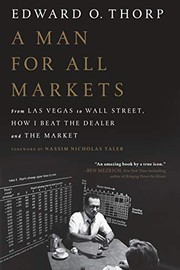
From beating blackjack with maths to pricing warrants and running a hedge fund.
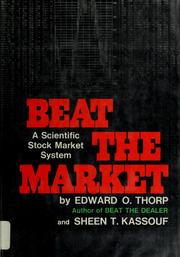
A method to price warrants and convertibles and hedge them against the stock.
The evidence that buying cheap, troubled companies beats more refined methods.
Recommended by: Mohnish Pabrai, Patrick O'Shaughnessy