Updates

  1. Person pages list letters, writing, profiles and links as sortable tables with filters, and show each person's companies as links; Fund letters show each letter's description in its own column.
  2. Experts show a checked job title and a short description of each person; 30 more people have photographs.
  3. Every company, fund, university and publication the experts work for has a page listing the people there.
  4. Fund letters show each letter's thesis and filter by it; 225 person pages list the essays, columns and newsletter issues the person wrote.
  5. Person pages list every essay and newsletter issue a person wrote, and their own books as a table in List view.
  6. Recommends shows the five largest kinds of book and the rest under More; browse pictures load sooner.
  7. Podcasts and talks link the original episode, filter by Audio and video or Press, and list each publisher once.
  8. Pages are wider, Recommends has List and Grid, and a filter clicked again turns off.
  9. Book cards sit in a ruled grid with Open Library and Goodreads links and each book's one-line note.
  10. Funds is now Investors; each investor's styles are buttons that filter the table.
  11. Podcasts and talks on a person's page filter by year and publisher and show as a list or a grid of pictures.
  12. Quotes show only people's own words: 472 summaries written by list sites are gone.
  13. Country pages open from Browse again, and every link on the shelf lands on a page.
  14. Subject and person pages show their sections as tabs, and each book appears once on a person's page.
  15. Book cards show the quote, who said it and the source; grids show five cards to a row.
  16. On a phone, a menu holds the sections, search, Updates, Feedback and dark mode.
  17. Feedback takes a screenshot of the page with no browser prompt, opens a screenshot full size when you click it, and clears itself once sent.
  18. Book cards are centred, search names the topic each book sits in, and any text cut short shows whole on hover.
  19. Search groups its results by kind: people, companies, geographies, subjects, topics, books, funds, fund letters and papers.
  20. The Books table lists who recommended each book by name, and the browser tab names the section you are in.
  21. Feedback can take a screenshot of the page, or one you paste or choose, and opens in the corner beside Updates.
  22. Each rail button reopens its section where you left it, and Browse, Table and People show on every book and subject page.
  23. Filters grey out choices that hold nothing instead of hiding them, and Books › People filters by authors or recommenders.
  24. Feedback takes a subject line and up to three screenshots.
  25. Biographies are grouped by the person they are about: 41 new pages, from Abraham Lincoln to Lee Kuan Yew.
  26. Sport splits into 23 sports, and Religion into one topic per faith.
  27. Book lists show as cards: the cover, one recommendation quote and every recommender by name.
  28. Seventeen subjects that had two or three pages under different names now have one page each.
  29. Every page lists its Experts as authors and recommenders, with a link to them on the Experts tab.
  30. Economics, Financial history, Financial panics and Accounting are subjects of their own, with one page per financial crisis.
  31. Book, person and subject pages open inside the app, so the tabs stay in view.
  32. 996 more book covers, and photographs or logos for 227 more people and companies.
  33. Books › Browse shows every subject as cards, and the rail holds Fund letters, Papers, Experts, Books and Funds.
  34. Every topic over 150 books splits into narrower topics, each with a page of its own.

Send feedback

What is it?
Screenshots, up to 3 (optional)
or paste one with Ctrl+V

We use your email only to reply to you.

What It Takes

What It Takes

Stephen A. Schwarzman
2019
T3 392 pages · about 6h 32m to read Open Librarygoodreads

Subtitled Lessons in the Pursuit of Excellence.

Summary

Schwarzman's memoir covers his upbringing, Yale, Harvard Business School, Lehman Brothers, and the founding and building of Blackstone from 1985 into the firm's current form as the largest alternative asset manager.

The business content covers the early fundraising, when he and Peterson were rejected repeatedly before Prudential anchored the first fund; the structural decisions including the choice to do friendly transactions only, which differentiated the firm from the hostile acquirers of the period; the diversification into real estate, credit and other strategies, which Schwarzman identifies as the decision that made Blackstone an asset manager rather than a buyout firm; the near-failure of an early investment in Edgcomb Steel and the change in investment process that followed, requiring a full partner review of every deal; and the 2007 public offering and the crisis that followed immediately.

His stated principles include hiring people better than yourself, pursuing large opportunities because they take the same effort as small ones, entering businesses only where you can be first or second, and treating difficulty in raising capital as information about the product rather than the market.

The book is a memoir by a very successful man about his own success, and it reads that way. It is thin on failures beyond those that produced a lesson, on the political and fee controversies the industry has faced, and on the criticisms of private equity's effects. The material on the firm's investment process and on the diversification decision is the most useful.

Key takeaways 7

  1. Blackstone pursued only friendly transactions, which differentiated it from the hostile acquirers of the 1980s and gave it access to sellers who would not deal with them.
  2. Diversifying into real estate, credit and other strategies turned the firm from a buyout house into an asset manager, which is what produced its scale.
  3. A single early investment failure led to a process requiring every deal to be reviewed by all partners with the case argued against, which was the durable institutional change.
  4. Large opportunities require the same effort as small ones, so the effort should be directed at the large ones.
  5. A firm should enter a business only where it can be first or second, since subscale positions consume management attention without producing returns.
  6. Difficulty raising capital is information about the product being offered rather than about the market's receptiveness.
  7. Permanent access to long-duration institutional capital is what allows a sponsor to buy during periods when other investors are forced to sell.

Who should read it

Investors and founders interested in how an alternative asset manager was built and the process discipline that followed an early failure.

About Stephen A. Schwarzman

Co-founder, chairman and CEO, Blackstone, 1985-present; previously managing director, Lehman Brothers

What It Takes is the definitive first-person account of how the modern alternative-asset firm was built, backed by one of the longest CEO tenures in finance.

Blackstone, Lehman Brothers

Similar books 6

Chosen by shared topics, the entries that hold them, and the people who recommended both.
David Carey, John E. Morris · 2010

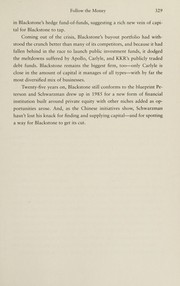
Blackstone from its 1985 founding through its 2007 public offering and the crisis.

Recommended by: Mohnish Pabrai

Eileen Appelbaum, Rosemary Batt · 2014

What private equity does to companies, workers and investor returns, critically.

Josh Kosman · 2009

Critical account of leverage and portfolio company outcomes across the big firms.
Antoin E. Murphy · 2004

Cross-holdings, the state and who actually controls French companies.

Stuart C. Gilson · 2001

Harvard case studies in bankruptcy and workout situations.

Where it sits in the reference 4

Investors
Companies
Business models
Biographies

Topics

Biography and MemoirFinance and MarketsInvestors, Traders and Gamblers