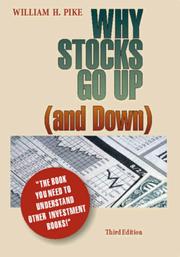
Why Stocks Go Up and Down
A plain-language primer on how securities work and what sets their prices.
Plain-language primer on financial statements and how securities work
Summary
Pike wrote an introductory text explaining how corporate securities work and what determines their prices, aimed at readers with no financial background. It has been revised through several editions, later with co-author Patrick Gregory.
The structure follows a company through its financing life. Pike starts with a small business raising money, introduces common stock and what a share represents, then adds debt, preferred stock and convertible securities, explaining in each case what the holder is entitled to and what happens in trouble. He builds the balance sheet and income statement from the transactions of the company being described rather than presenting them as abstract forms, which makes the accounting section unusually concrete. He then covers earnings per share, book value, dividends, and the ratios investors use, before turning to bond pricing, yield, the relationship between interest rates and bond prices, and finally to what determines stock prices.
The treatment of stock valuation is conventional: prices reflect expected future earnings discounted at a rate that varies with interest rates and perceived risk, so stock prices move on changes in expected earnings, in interest rates and in risk appetite.
The book is a primer and does not attempt to be more. It contains no original argument and no advanced material on options, derivatives or portfolio theory. Its value is that the explanations are genuinely clear and the accounting is built up from transactions rather than asserted. Readers with a finance background will find nothing new.
Key takeaways 7
- A share of common stock is a residual claim, so its holder receives whatever remains after every other claimant is satisfied.
- Financial statements are best understood by constructing them from the transactions of a business rather than by learning the formats.
- Bond prices move inversely to interest rates because the fixed coupon must be repriced to the current required yield.
- Preferred stock and convertible securities sit between debt and equity, and their terms determine which they resemble in practice.
- Earnings per share can be increased through financing decisions that do not improve the underlying business.
- Stock prices change on revisions to expected future earnings, to interest rates, and to the risk premium investors demand.
- Book value records what was paid for assets rather than what they are worth, which limits its use in valuation.
Who should read it
Readers new to finance who want securities and financial statements explained from first principles before moving to investment texts.
Who recommended it 1 · 1 direct
“I highly recommend Janet Lowe's Value Investing Made Easy as a primer. I'd follow that book with Why Stocks Go Up (and Down) by William Pike.”
Similar books 6
Chosen by shared topics, the entries that hold them, and the people who recommended both.
How to read financial statements sceptically and value bonds and stocks.
“I am reminded once again of the quote that sits in the front of Ben Graham’s Security Analysis, from Horace’s Ars Poetica: “Many shall be restored that now are fallen and many shall fall that now are in honor.” — Bill Miller
Source: 2007 Q3 Market Commentary
Recommended by: Bill Miller, Christopher Bloomstran and 18 others
Barton Biggs's market commentary as Morgan Stanley's global strategist.
Why buy-and-hold is over for now, and how to aim where the market is going.
Recommended by: Mohnish Pabrai
Investing tips, maxims and truisms organized by topic, from equities to trading.
Recommended by: Mohnish Pabrai
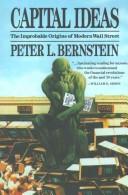
How Markowitz, Sharpe, Fama, Black and Scholes built the theory of modern finance.
“But it was in his Capital Ideas, published in 1992, that I first learned of Louis Bachelier’s 1900 dissertation, The Theory of Speculation.” — John C. Bogle
Source: Success In Investment Management: What Can We Learn From Indexing?, page 1
Recommended by: John C. Bogle, Michael Mauboussin
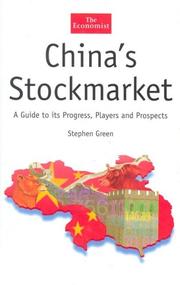
A guide to China's stock market: how it grew, who trades in it and its prospects.
Recommended by: Mohnish Pabrai
Where it sits in the reference 2
Topics 2
As an Amazon Associate I earn from qualifying purchases.