A Man for All Markets
Thorp applied Kelly to blackjack, then to convertible arbitrage.
Summary
Thorp's memoir covers a career in which he solved blackjack mathematically, wrote the first proof that the game could be beaten, tested it in Nevada casinos, then applied the same approach to warrant and convertible pricing and ran one of the first market-neutral hedge funds.
The intellectual content is the transfer of method. Thorp's blackjack work established that a small quantifiable edge combined with correct bet sizing produces reliable growth, and the Kelly criterion supplied the sizing rule. He then applied the same structure to securities: identify a mispricing between related instruments, hedge out the market exposure, size positions by edge, and repeat. With Kassouf he worked out warrant pricing before Black and Scholes published, and he was using a version of the option formula in trading before the paper appeared. Princeton Newport Partners ran from 1969 to 1988 with positive returns in every year.
The personal material includes his conclusion in the early 1990s, from examining the reported returns, that Bernard Madoff's operation could not be genuine, years before the collapse. He also covers the prosecution that closed Princeton Newport, in which the firm's partners were charged in a case connected to Milken and Drexel and the convictions were subsequently overturned.
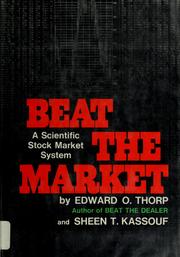
The book is a memoir and the investment method is described rather than taught. Readers wanting the technique should read Beat the Market. Its value is the demonstration that the same analytical structure applies to games and to markets, and the first-hand account of how a quantitative edge is found and sized.
Key takeaways 7
- A small quantifiable edge combined with correct position sizing produces reliable growth, and the sizing rule matters as much as the edge.
- The same analytical structure applies to blackjack and to securities: find a measurable mispricing, hedge the exposure you are not paid for, and size by edge.
- Thorp derived a working option pricing method before Black and Scholes published, and used it in trading rather than publishing it.
- Market-neutral hedging removes the exposure an investor has no advantage in, which is what allows a small edge to be repeated at scale.
- Madoff's reported return series was inconsistent with any real trading strategy, and this was determinable from the numbers alone years before the collapse.
- Casinos and markets both respond to a demonstrated edge by changing the conditions, so any edge has a finite life and must be replaced.
- Independent verification of any claimed track record is possible from the reported data itself, and most investors never attempt it.
Who should read it
Investors interested in how a quantifiable edge is identified, hedged and sized, told first-hand by the person who did it in two different domains.
About Edward O. Thorp
Mathematician; founder, Princeton/Newport Partners 1969-1988 and Ridgeline Partners 1994-2002
Turned the Kelly criterion and warrant-pricing math into the first quantitative hedge fund, and his books are primary sources for both card counting and convertible arbitrage.
Where it sits in the reference 4
Similar books 6
Chosen by shared topics, the entries that hold them, and the people who recommended both.