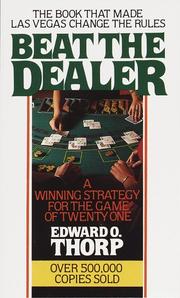
Beat the Dealer
Revised second edition 1966 is the standard text.
Summary
Thorp, a mathematics professor, published the first mathematically demonstrated winning strategy for a casino game. He used an IBM 704 to compute optimal blackjack play and to establish that the composition of the remaining deck changes the player's expected value, because blackjack, unlike roulette or dice, has dependent trials.
The core finding is that removing small cards from the deck favours the player while removing tens and aces favours the house. From this Thorp derived counting systems, beginning with a ten-count that tracks the ratio of tens to non-tens, and later simpler point-count systems. When the count indicates a favourable deck the player raises the bet and deviates from basic strategy in specific ways; when it does not, the player bets the minimum. He also set out basic strategy, meaning the correct play for every hand against every dealer up-card assuming no counting, which by itself reduces the house edge to a fraction of a per cent.
The money management framework matters as much as the counting. Thorp applied the Kelly criterion, which sets bet size as a fraction of bankroll proportional to the edge, to keep the probability of ruin low while maximising long-run growth. That framework transferred directly to his later work in markets, described in A Man for All Markets.
Casinos changed their rules and procedures in response, introducing multiple decks, more frequent shuffling, cut cards and restrictions on bet spread, which reduced the edge substantially. The specific counting systems are therefore of limited practical use today. The book's durable content is the demonstration that a small identifiable edge, combined with correct sizing and enough repetitions, produces reliable profit, and the Kelly framework for sizing it.
Key takeaways 7
- Blackjack has dependent trials, so the expected value of the next hand changes with the cards already dealt.
- Removing small cards from the remaining deck shifts the advantage to the player while removing tens and aces shifts it to the house.
- Correct basic strategy alone reduces the house edge to well under one per cent before any counting is applied.
- Profit comes from varying bet size with the count, not from playing hands differently, because the edge is small even when favourable.
- Bet size should be proportional to the edge as a fraction of bankroll, which is what keeps the probability of ruin acceptable.
- A small, reliably identified edge repeated many times produces a certain profit, while a large uncertain edge does not.
- Publishing a winning system causes the counterparty to change the rules, which is the general fate of disclosed edges.
Who should read it
Investors and traders who want the original demonstration that a quantified edge plus disciplined sizing produces reliable returns.
About Edward O. Thorp
Mathematician; founder, Princeton/Newport Partners 1969-1988 and Ridgeline Partners 1994-2002
Turned the Kelly criterion and warrant-pricing math into the first quantitative hedge fund, and his books are primary sources for both card counting and convertible arbitrage.
Where it sits in the reference 3
Similar books 6
Chosen by shared topics, the entries that hold them, and the people who recommended both.