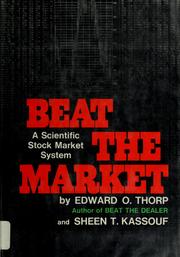
Beat the Market
The convertible and warrant hedge that started quantitative arbitrage.
Summary
Thorp and Kassouf published the first systematic method for pricing and hedging convertible securities, and it is the foundation of what became convertible arbitrage and, more broadly, of derivative hedging as a trading business.
The method works from the relationship between a warrant or convertible bond and the underlying common stock. Thorp and Kassouf derived an empirical formula for the value of a warrant as a function of the stock price, the exercise price and the time to expiry, and showed that warrants were frequently overpriced relative to that value. The trade is to sell the overpriced warrant and buy a calculated quantity of the underlying stock, so that small movements in the stock price leave the position's value unchanged. They give the hedge ratio calculation, which is the derivative of the warrant value with respect to the stock price, and explain that the ratio must be adjusted as the stock moves, which is delta hedging described before the term existed.
The book predates Black and Scholes by six years. Thorp's formula was empirical rather than derived from a no-arbitrage argument, which is what Black, Scholes and Merton supplied, but the practical trading implication is the same.
The specific market conditions described are from the 1960s and the warrant mispricings the book identifies no longer exist at that scale, precisely because the book and its successors eliminated them. It is worth reading for the reasoning, which is unusually clear, and as the origin of hedged derivative trading as an investment approach.
Key takeaways 7
- A warrant or convertible can be hedged against its underlying stock so that small price movements leave the combined position unchanged.
- The correct hedge ratio is the rate of change of the derivative's value with respect to the stock price, and it must be adjusted as the stock moves.
- Warrants were systematically overpriced in the 1960s market, and selling them hedged produced returns with little exposure to market direction.
- A relationship between two related securities can be traded even when the direction of either is unknown, which is the foundation of arbitrage as a business.
- An empirical pricing relationship is sufficient for trading even without a theoretical derivation, which Thorp demonstrated six years before Black and Scholes.
- The value of a warrant depends on the volatility of the underlying stock and the time remaining, which is why identical stock prices support different warrant prices.
- Publishing a profitable method eliminates it, and the mispricings described here disappeared as the technique spread.
Who should read it
Investors interested in the origin of hedged derivative trading and the clearest early statement of how a delta hedge works.
About Edward O. Thorp
Mathematician; founder, Princeton/Newport Partners 1969-1988 and Ridgeline Partners 1994-2002
Turned the Kelly criterion and warrant-pricing math into the first quantitative hedge fund, and his books are primary sources for both card counting and convertible arbitrage.
Where it sits in the reference 4
Similar books 6
Chosen by shared topics, the entries that hold them, and the people who recommended both.