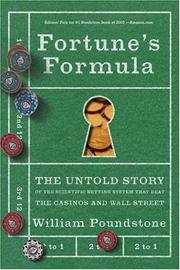
Fortune's Formula: The Untold Story of the Scientific Betting System That Beat the Casinos and Wall Street
Kelly criterion and information theory: the intellectual lineage Medallion trades on.
Summary
Poundstone tells the history of the Kelly criterion, the position-sizing formula derived by John Kelly at Bell Labs in 1956 from Claude Shannon's information theory, and follows it through gambling, hedge funds and academic dispute.
The formula specifies the fraction of capital to bet to maximise the long-run growth rate of wealth, which for a favourable bet equals the edge divided by the odds. Its properties are that it maximises the expected logarithm of wealth, that it never risks ruin, and that it produces higher long-run growth than any other strategy while producing large drawdowns along the way.
The narrative covers Shannon and Kelly at Bell Labs; Ed Thorp, who used it in card counting after solving blackjack and then in Princeton Newport Partners, one of the first quantitative hedge funds; the connection to organised crime through the wire services and to the Las Vegas casinos; the academic fight in which Paul Samuelson attacked the criterion vigorously and at length, arguing that it does not follow from expected utility maximisation for investors whose utility function differs from the logarithm; and the failure of Long-Term Capital Management, which Poundstone uses to contrast leverage without a growth-optimal constraint.
The book covers the mathematics lightly, which makes it accessible and means a reader wanting to apply the formula will need another source. Poundstone spends substantial space on the organised crime and casino history, which some readers find a digression. The Samuelson objection is real and the practical use of the criterion generally involves betting a fraction of the Kelly amount, because full Kelly produces drawdowns most investors cannot tolerate.
Key takeaways 8
- The Kelly criterion specifies the bet size that maximises the long-run growth rate of wealth, equal to the edge divided by the odds.
- Betting the Kelly fraction never risks ruin, because the size falls proportionally as capital falls.
- Betting more than the Kelly fraction reduces long-run growth while increasing risk, which makes overbetting strictly worse rather than a trade-off.
- Full Kelly produces drawdowns most investors cannot tolerate, which is why practitioners generally bet a fraction of the calculated amount.
- Position sizing rather than selection determines long-run outcomes once an edge exists, which reverses where most investors direct effort.
- Thorp applied the criterion first to blackjack and then to convertible arbitrage, producing consistent returns over decades in one of the first quantitative funds.
- Samuelson argued at length that the criterion does not follow from expected utility maximisation unless the investor's utility happens to be logarithmic.
- A strategy that maximises expected value rather than expected growth rate can produce ruin, since the average outcome across paths is not the outcome on any single path.
Who should read it
Investors who want the history and intuition behind growth-optimal position sizing before applying it, understanding that full Kelly is rarely practical.
About William Poundstone
American science and business writer covering game theory, probability, pricing psychology and decision-making.
Fortune's Formula traces the Kelly criterion from Bell Labs information theory to Ed Thorp's blackjack and hedge-fund bet sizing, and it remains the standard entry point to position sizing under an edge. Priceless collects the experimental work on how buyers anchor and compare prices, which transfers straight into pricing decisions.
Where it sits in the reference 9
Who recommended it 1 · 1 direct
Similar books 6
Chosen by shared topics, the entries that hold them, and the people who recommended both.