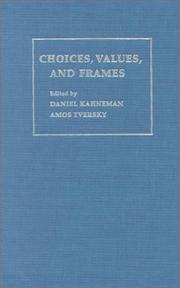
Choices, Values, and Frames
Edited volume; Open Library lists first publication 1985.
Summary
Kahneman and Tversky edited this collection of the research on decision making under risk that they and their collaborators produced from the late 1970s onward. It is a companion volume to Judgment Under Uncertainty, which covered heuristics and biases, and it collects the papers on preference rather than on belief.
The centre is prospect theory, first published in Econometrica in 1979 and revised as cumulative prospect theory in 1992, both reprinted here. Its components are specific and each contradicts expected utility theory. Outcomes are evaluated as gains and losses relative to a reference point rather than as final states of wealth. The value function is concave for gains and convex for losses, so people take risks to avoid losses that they would not take to secure gains. Losses count roughly twice as much as equivalent gains, which is loss aversion. Probabilities enter through a weighting function that overweights small probabilities and underweights moderate to large ones, which explains the simultaneous purchase of lottery tickets and insurance.
The framing papers show that logically equivalent descriptions of the same choice produce systematically different preferences, demonstrated with the Asian disease problem and with medical treatment framed by survival or mortality rates. Further papers cover mental accounting, the endowment effect and status quo bias, preference reversals, the discrepancy between choice and pricing, and the papers on experienced versus remembered utility including the peak-end rule.
This is a collection of technical journal papers, not a general book; Kahneman's Thinking, Fast and Slow presents the same material for general readers. Some contributors' work in the wider behavioural literature has faced replication problems, but prospect theory's core findings have replicated widely, including across cultures and with substantial financial stakes.
Key takeaways 7
- People evaluate outcomes as gains and losses from a reference point rather than as final levels of wealth.
- Losses count roughly twice as heavily as equivalent gains, which is a measured parameter rather than a metaphor.
- People take risks to avoid a certain loss that they refuse when the same gamble is framed as a possible gain.
- Small probabilities are overweighted and moderate ones underweighted, which explains buying lottery tickets and insurance simultaneously.
- Logically equivalent descriptions of the same decision produce reliably different choices, so there is no neutral way to present options.
- The endowment effect means people demand more to give up an object than they would pay to acquire it.
- Preferences reverse depending on whether people choose between options or price them separately, which means preferences are constructed rather than retrieved.
Who should read it
Readers who need the primary research on prospect theory and framing rather than a popular account, particularly anyone designing pricing, contracts or choice architecture.
About Daniel Kahneman
Eugene Higgins Professor of Psychology Emeritus, Princeton University; Nobel laureate in economics 2002
Prospect theory and the heuristics-and-biases programme are the primary psychological foundation the whole of behavioral finance builds on.
Where it sits in the reference 3
Similar books 6
Chosen by shared topics, the entries that hold them, and the people who recommended both.