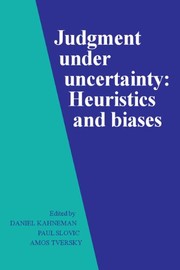
Judgment under Uncertainty: Heuristics and Biases
Edited volume; Open Library lists first publication 1981.
Summary
Daniel Kahneman, Paul Slovic and Amos Tversky assembled this collection of thirty-five papers in 1982, and it established the heuristics and biases programme as a field. The organising claim is that people making judgements under uncertainty do not compute probabilities; they substitute a small number of mental shortcuts that produce systematic and predictable errors.
Three heuristics carry most of the volume. Representativeness: people judge the probability that an object belongs to a category by how closely it resembles the category, which makes them ignore base rates, sample size and prior probability. Availability: people judge frequency by how easily instances come to mind, which makes vivid and recent events seem more common than they are. Anchoring and adjustment: people start from whatever number is present and adjust insufficiently. The collection also covers overconfidence in calibration studies, the illusion of validity, hindsight bias, the misperception of randomness, and applications to expert judgement in medicine, forecasting and risk perception.
The volume is a research collection, dense and repetitive by design, and readers wanting the argument should start with Kahneman's Thinking, Fast and Slow. Some specific findings have not replicated well, and the field has been criticised for testing student subjects on artificial problems and for underweighting Gerd Gigerenzer's argument that many of the errors disappear when problems are stated in frequency format rather than probability format. The core findings on base rate neglect, overconfidence and anchoring have survived and are the empirical basis for most of what investors now call behavioural finance.
Key takeaways 7
- People judge probability by resemblance to a category and consequently ignore base rates even when they know them.
- Judgements of frequency track how easily examples come to mind, so vivid and recent events are systematically overweighted.
- Numerical estimates anchor on whatever value is available beforehand, including values known to be arbitrary.
- Experts show the same biases as novices, and their confidence rises with the amount of information they receive while accuracy does not.
- People expect small samples to resemble the populations they come from, which produces false confidence in short track records.
- Calibration studies show that intervals people describe as ninety-eight per cent confident contain the true value far less often.
- Hindsight bias makes past outcomes appear more predictable than they were, which corrupts learning from experience.
Who should read it
Investors and decision-makers who want the primary research behind behavioural finance rather than its popularised versions.
About Daniel Kahneman
Eugene Higgins Professor of Psychology Emeritus, Princeton University; Nobel laureate in economics 2002
Prospect theory and the heuristics-and-biases programme are the primary psychological foundation the whole of behavioral finance builds on.
Where it sits in the reference 2
Similar books 6
Chosen by shared topics, the entries that hold them, and the people who recommended both.