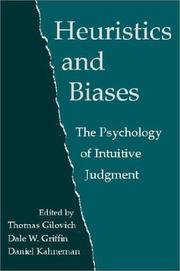
Heuristics and Biases: The Psychology of Intuitive Judgment
Edited volume.
Summary
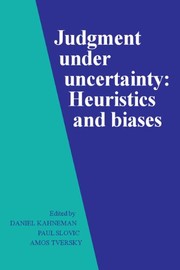
Gilovich, Griffin and Kahneman edited this collection as the successor to the 1982 volume Judgment Under Uncertainty, gathering the research on intuitive judgement produced in the intervening two decades.
The organising development is the two-system framework. Kahneman and Frederick's chapter sets out the distinction between an intuitive system that produces rapid automatic responses and a deliberative system that monitors and sometimes corrects them, and introduces attribute substitution as the general mechanism behind heuristics: when asked a difficult question, people answer an easier related one without noticing the substitution. This framework organised the field and became the basis for Kahneman's later Thinking, Fast and Slow.
The collection extends the original heuristics. Representativeness, availability and anchoring are revisited with newer evidence and with the mechanisms specified more precisely, including the finding that availability operates through the experienced ease of retrieval rather than through the number of instances retrieved. New chapters cover the affect heuristic, in which an overall good or bad feeling substitutes for separate assessments of risk and benefit; support theory, which explains why unpacking a category into its components raises its judged probability; and the treatment of the outside view against the inside view in forecasting.
Other sections cover overconfidence and calibration, the illusion of validity, hindsight bias, motivated reasoning, cultural differences in judgement, and applications to medical, legal and financial decisions.
The collection is academic and consists of journal-style chapters. Some of the specific findings it collects have been affected by the replication problems that hit social psychology after 2011, particularly in the priming literature, though the core judgement findings on anchoring, availability, representativeness and overconfidence have replicated well. Thinking, Fast and Slow presents the same material for general readers.
Key takeaways 7
- When asked a difficult question people answer an easier related one without noticing the substitution, which is the general mechanism behind heuristics.
- An intuitive system produces rapid automatic judgements that a deliberative system sometimes monitors and rarely corrects.
- Availability operates through the experienced ease of retrieval rather than through the number of instances actually retrieved.
- An overall good or bad feeling about something substitutes for separate assessments of its risks and its benefits.
- Unpacking a category into its components raises the judged probability of the whole, which is logically impossible.
- Taking the outside view by using base rates from comparable cases produces better forecasts than analysing the case from within.
- Confidence in a judgement tracks the coherence of the story constructed rather than the quality of the evidence supporting it.
Who should read it
Readers who want the primary research on intuitive judgement rather than a popular treatment, particularly anyone designing decision or forecasting processes.
About Daniel Kahneman
Eugene Higgins Professor of Psychology Emeritus, Princeton University; Nobel laureate in economics 2002
Prospect theory and the heuristics-and-biases programme are the primary psychological foundation the whole of behavioral finance builds on.
Where it sits in the reference 2
Similar books 6
Chosen by shared topics, the entries that hold them, and the people who recommended both.