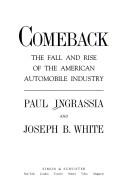
Comeback: The Fall and Rise of the American Automobile Industry
Detroit's early-1990s crisis and the GM boardroom coup.
Summary
Ingrassia and White, Wall Street Journal reporters who shared a Pulitzer for their Detroit coverage, wrote this account of the American automobile industry from the late 1970s crisis through the early 1990s recovery.
The period covered is the one in which Detroit lost roughly a third of its market to Japanese manufacturers and then began responding. The book covers the Chrysler bailout and Iacocca's tenure, the Ford Taurus programme which was the first American product genuinely competitive on quality, the NUMMI joint venture in which General Motors learned the Toyota production system directly and largely failed to transfer the lessons to its other plants, the Saturn project, and the boardroom revolt at General Motors in 1992 that removed Robert Stempel.
Their explanation of the failure emphasises complacency built during a period of no real competition, a management culture in which finance controlled product decisions, and labour agreements accumulated over decades that made cost reduction impossible. Their account of the recovery emphasises specific product programmes and the individuals who protected them from the normal process.
The title's optimism was premature. The industry's recovery in the early 1990s was partial and both General Motors and Chrysler entered bankruptcy in 2009, which Ingrassia's later book Crash Course covers. Read this as the account of one cycle within a longer decline, written when the outcome looked better than it proved.
Key takeaways 7
- American manufacturers lost roughly a third of their market to Japanese competitors before responding, because they disputed the quality evidence for years.
- The NUMMI joint venture taught General Motors the Toyota production system directly, and the company largely failed to transfer what it learned to its other plants.
- The Ford Taurus was the first American product competitive on quality, and it succeeded because a team was protected from the normal development process.
- Financial control of product decisions produced vehicles designed to hit cost targets rather than to be chosen by customers.
- Labour agreements accumulated over decades made cost reduction structurally impossible without a crisis large enough to reopen them.
- The 1992 boardroom revolt at General Motors demonstrated that outside directors could act, and it came roughly a decade after the problems were visible.
- The recovery the book describes was partial, and both General Motors and Chrysler entered bankruptcy fifteen years later.
Who should read it
Operators studying incumbent responses to a superior competitor and why organisational learning fails to transfer internally.
Where it sits in the reference 2
Who recommended it 1 · 1 direct
Similar books 6
Chosen by shared topics, the entries that hold them, and the people who recommended both.