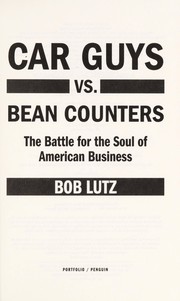
Car Guys vs. Bean Counters
Insider account: Lutz on product culture versus finance control.
Summary
Lutz ran product development at General Motors from 2001 to 2010 after a career at BMW, Ford and Chrysler, and this is his account of what went wrong at GM and what he tried to change. His argument is that the company was captured by finance and process people who treated cars as interchangeable units of cost and revenue, and who used market research, brand management theory and cost targets to strip out the specific product decisions that make customers want a particular vehicle.
The examples are concrete: interior materials chosen to hit a cost per vehicle, styling committees that averaged away distinctive designs, platform sharing pushed past the point where the resulting cars were differentiable, brand managers with no engineering knowledge setting product direction, and a quality metric that rewarded conformance to specification rather than whether the specification was any good. Lutz describes reorganising design authority, killing the brand management structure, and pushing through products including the Cadillac CTS, the Chevrolet Malibu and the Volt.
The book is a valuable operator's account of how measurement systems distort product organisations, and the general lesson applies well beyond cars: what you can measure crowds out what actually determines demand. It is also a memoir by a self-interested participant. Lutz claims credit broadly, treats his own product judgement as self-evidently correct, and gives thin treatment to GM's legacy pension and healthcare costs, its dealer network, its labour agreements and its balance sheet, all of which contributed at least as much to the 2009 bankruptcy as product mediocrity did.
Key takeaways 7
- Companies run by financial control functions optimise the measurable inputs of a product and destroy the unmeasurable qualities that make customers choose it.
- Product decisions should sit with people who have deep domain knowledge of the product, not with brand managers trained in general marketing.
- Consumer research reliably describes what customers currently like and cannot identify what they would like if it existed.
- Cost targets applied uniformly across a vehicle guarantee that money is saved in the places customers actually touch and notice.
- Quality measured as conformance to specification rewards building a mediocre design accurately.
- Platform sharing yields real savings up to the point where customers can perceive the shared content, after which it destroys pricing power.
- A large organisation's design decisions get averaged by committee review, and preserving a strong product requires protecting it from that process.
Who should read it
Operators and product leaders who want a first-hand account of how financial control systems degrade product decisions inside a large company.
Where it sits in the reference 4
Who recommended it 1 · 1 direct
Similar books 6
Chosen by shared topics, the entries that hold them, and the people who recommended both.