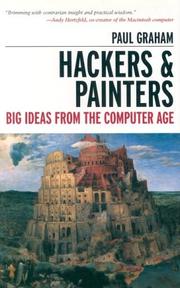
Hackers & Painters
Subtitled 'Big Ideas from the Computer Age'; collects early essays
Summary
Graham collects essays written around 2001 to 2004 on programming, startups, wealth creation and independent thinking. The title essay argues that programmers are makers rather than scientists, that programming resembles painting more than mathematics, and that the practice of designing while building is legitimate rather than sloppy.
The most cited essays are How to Make Wealth and Mind the Gap. The first argues that wealth is not money and is not zero-sum, that a startup is a mechanism for compressing a working life into a few years in order to obtain measurement and leverage, and that the two requirements are measurement of individual contribution and leverage over outcomes. The second argues that income inequality partly reflects genuine differences in what people produce, and that technology increases the productivity gap between the most and least effective people in any field.
Other essays cover the argument that popular programming languages are not the most powerful ones, that Lisp gave Viaweb a competitive advantage his competitors could not match, that spam can be filtered with Bayesian methods, which Graham demonstrated practically, and that schools produce social hierarchies that reward conformity and punish independent thinking.
The essays date from a specific period and Graham's later writing at Y Combinator supersedes some of them. The programming language arguments are contested by many working programmers, and the Lisp advantage claim rests on a single case. The Mind the Gap argument is politically contentious and Graham asserts more than he demonstrates. The essays about what startups are for and about measurement and leverage remain the clearest short statement of the case.
Key takeaways 8
- Wealth is what people want and is created rather than transferred, which means the total is not fixed and taking a share is not the only way to become rich.
- A startup compresses a working life into a few years, which is why the returns can be large and why the work is unpleasant.
- Creating wealth requires both measurement of individual contribution and leverage over outcomes, and ordinary employment provides neither.
- Small groups produce more per person than large ones because measurement is possible and the effort of individuals is visible.
- Programming is a design activity performed while building rather than a specification executed afterwards, which resembles painting more than engineering.
- A more powerful programming language provides a real competitive advantage that competitors cannot see, because they cannot evaluate what they do not use.
- Technology increases the gap in output between the most and least productive people in any field, which produces measured inequality independent of any unfairness.
- Schools generate social hierarchies that reward conformity, which is why people who later do original work were often unpopular in them.
Who should read it
Technical founders who want the early statement of Graham's argument about what startups are for and why measurement and leverage matter.
About Paul Graham
Co-founder of Viaweb and Y Combinator; essayist and Lisp programmer
His essay archive is the primary source that the modern startup canon quotes, argues with and reuses; the essays matter more than the books.
Where it sits in the reference 2
Who recommended it 6
Similar books 6
Chosen by shared topics, the entries that hold them, and the people who recommended both.