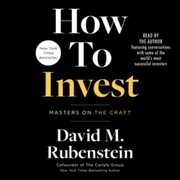
How to Invest
Interviews with Marks, Dalio, Simons, Schwarzman and other investors.
Summary
David Rubenstein, co-founder of Carlyle, interviews roughly two dozen investors across asset classes and prints the conversations with short introductions. The subjects include Larry Fink, Ray Dalio, Seth Klarman, Stan Druckenmiller, Jim Simons, Mary Erdoes, Marc Andreessen, Sandra Horbach, John Paulson and Michael Moritz, organised by category: public equities, distressed debt, hedge funds, private equity, venture capital, real estate, credit and infrastructure.
The book's function is orientation rather than instruction. Each chapter establishes what a given asset class actually involves, how the practitioners think about sourcing and risk, and how they describe their own edge. Rubenstein asks consistent questions about how the subject entered the business, what mistakes they made, and what they look for in people they hire. The answers are more candid than a conference panel and less detailed than a serious methodological account.
The limitation is survivorship. Every subject has a long record of success, and none is asked hard questions about fee structures, benchmark selection or the role of luck in their results. Rubenstein is a peer rather than a journalist, and the tone reflects that. Readers wanting an argument about how to invest will not find one; readers wanting a competent map of who does what in institutional asset management, and in the words of the people doing it, will.
Key takeaways 6
- Investment approaches that work are usually narrow, and almost every subject describes deliberately staying inside a defined competence.
- Most of the interviewees attribute their entry into the business to accident rather than to plan.
- Private market returns depend more on sourcing proprietary deals than on analysis of deals everyone sees.
- Successful managers describe institutional structures that let them hold positions through drawdowns, which is a capital-base question rather than an analytical one.
- Several subjects state that they hire for curiosity and independence rather than for finance credentials.
- Rubenstein argues that individual investors should concentrate on low-cost index exposure and treat the alternatives described here as institutional products.
Who should read it
Readers new to institutional investing who want a survey of asset classes and practitioners before choosing where to specialise.
About David M. Rubenstein
Co-founder and co-chairman, The Carlyle Group, 1987-present; host, The David Rubenstein Show
Built one of the largest private equity firms and has become the most prolific interviewer of investors and leaders, turning those conversations into a widely read book series.
Where it sits in the reference 2
Similar books 6
Chosen by shared topics, the entries that hold them, and the people who recommended both.