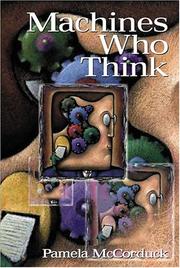
Machines Who Think
The first hype cycle recorded as it happened.
Summary
Pamela McCorduck wrote the first history of artificial intelligence, based on interviews with the researchers who founded the field while most of them were still working. Her subjects include John McCarthy, Marvin Minsky, Allen Newell, Herbert Simon, Edward Feigenbaum, Joseph Weizenbaum and Seymour Papert.
The book covers the intellectual prehistory, from mechanical automata and Leibniz through Babbage and Turing, and then the founding period: the 1956 Dartmouth workshop, the Logic Theorist and General Problem Solver at Carnegie Mellon, the work at MIT and Stanford, and the expert systems of the 1970s including DENDRAL and MYCIN. McCorduck reports the specific predictions researchers made and the confidence with which they made them, which is why the book has value beyond its historical content: it documents a forecasting record.
She also covers the objections, including Hubert Dreyfus's argument that human expertise is not rule-following, Weizenbaum's ethical criticism, and the debate over whether symbol manipulation could produce understanding. Later editions extend the story but the core remains a portrait of the symbolic period. The book predates the connectionist revival, the machine learning era and everything that followed, so it is a period document about an approach that largely failed. That is precisely its use for a reader assessing current claims about the field.
Key takeaways 7
- The founders of artificial intelligence made specific timelines for human-level performance and missed them by decades.
- The field began with the assumption that intelligence consists of symbol manipulation according to rules, which shaped thirty years of research.
- Expert systems succeeded in narrow domains with codifiable rules and failed wherever expertise resisted explicit statement.
- Dreyfus argued that human competence rests on unarticulated background knowledge rather than on rules, and the field's failures supported him.
- McCorduck argues that the desire to build thinking machines is continuous with much older human projects rather than a product of computing.
- Funding for the field moved in cycles driven by the promises researchers made rather than by results delivered.
- Weizenbaum's objection was that some tasks should not be delegated to machines regardless of whether machines could perform them.
Who should read it
Investors and technologists assessing current artificial intelligence claims who want a documented record of how the field's earlier confident predictions performed.
Where it sits in the reference 2
Similar books 6
Chosen by shared topics, the entries that hold them, and the people who recommended both.