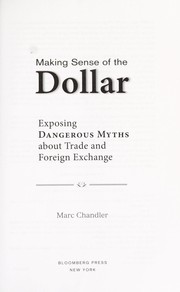
Making Sense of the Dollar
Working FX strategist on what actually moves the dollar.
Summary
Marc Chandler was a currency strategist at Brown Brothers Harriman, and this book attacks a set of beliefs about the dollar and the American economy that he considers empirically wrong. It is organised as a series of arguments against propositions rather than as a positive theory of exchange rates.
The propositions he disputes include: that the current account deficit means the United States lives beyond its means and must eventually face a dollar collapse; that American manufacturing has declined, which he answers with output data showing production near record levels with employment falling because of productivity; that foreign central banks fund the American deficit and could stop; that the dollar's reserve currency status is eroding; and that a weaker dollar reliably improves the trade balance. On the current account he makes the argument that sales by American-owned foreign affiliates dwarf exports, so the standard trade accounts misrepresent the position of American firms in world markets.
Chandler is a market practitioner writing against widely held views, and he states his case more confidently than the data always support, particularly on the durability of dollar dominance. The book appeared in 2009 and readers should update it: the shale revolution changed the energy component of the trade balance, quantitative easing changed central bank behaviour, and the sanctions of the 2020s reopened the reserve-currency question he treats as settled. The framework for reading current account data and for separating trade flows from ownership remains useful.
Key takeaways 7
- American manufacturing output has kept rising while manufacturing employment fell, so job loss reflects productivity rather than decline.
- Sales by American-owned foreign affiliates far exceed American exports, which makes the trade balance a poor measure of competitive position.
- Current account deficits reflect capital inflows as much as they reflect trade, and the causation runs in both directions.
- Foreign central bank holdings of Treasuries are a consequence of those countries' exchange rate policies rather than a favour to the United States.
- Chandler argues that no currency is positioned to replace the dollar because none offers comparable market depth and legal certainty.
- Exchange rate movements pass through to trade balances slowly and incompletely, so devaluation is a weak instrument for correcting deficits.
- Popular narratives of American economic decline rest on employment statistics rather than on output or productivity data.
Who should read it
Investors with currency exposure who want a practitioner's argument against the standard dollar-decline thesis, updated for events since 2009.
Where it sits in the reference 2
Similar books 6
Chosen by shared topics, the entries that hold them, and the people who recommended both.