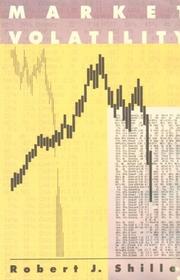
Market Volatility
Summary
Robert Shiller collected his research papers from the late 1970s and 1980s in this volume, along with connecting commentary. The central body of work is the variance bounds tests, which asked whether stock prices move more than the present value of subsequent dividends can justify.
The argument runs as follows. Under the efficient markets model, a stock price equals the expected present value of future dividends. Because a price is a forecast of that present value, and forecasts are less variable than what they forecast, price volatility should be bounded by the volatility of the realised discounted dividend stream. Shiller compared actual price series with the ex post rational price computed from realised dividends and found prices far more volatile than the bound allows. He drew the conclusion that something other than rational expectations about dividends drives prices, and proposed models in which fads, social dynamics and shifting popular opinion play a role.
The collection also contains work on bond market volatility, on real estate, on the term structure, and on survey evidence about investor expectations. The variance bounds tests were attacked heavily on econometric grounds, particularly for the treatment of non-stationarity in dividends and for the assumption of a constant discount rate; Marsh and Merton and others published rebuttals, and Shiller responds. The debate was never settled cleanly, and the modern position, associated with Cochrane, is that most price variation reflects changing discount rates rather than changing dividend expectations, which is consistent with Shiller's data and not with his interpretation. The papers remain the foundation of behavioural finance.
Key takeaways 7
- Stock prices move far more than the subsequent realised dividend stream can justify under a constant discount rate.
- Shiller argues that fashions and social dynamics in investor opinion contribute to price movements independently of fundamentals.
- Volatility tests provide a way to reject the efficient markets model that does not depend on identifying a profitable trading strategy.
- Survey evidence shows investor expectations extrapolate recent returns, which contradicts the rational expectations assumption directly.
- Bond and real estate markets show similar excess volatility relative to the fundamentals that should determine them.
- The debate over excess volatility turns on whether discount rates vary over time, and Shiller's tests assume they do not.
- Market prices can be informative about relative values while still being poor estimates of fundamental value in aggregate.
Who should read it
Investors and researchers who want the primary papers behind the excess volatility argument and the empirical origins of behavioural finance.
About Robert J. Shiller
Sterling Professor of Economics Emeritus, Yale University; co-creator of the Case-Shiller home price indices; Nobel laureate in economics 2013
Excess-volatility work and Irrational Exuberance are the primary sources for the empirical case that asset prices move far more than fundamentals justify.
Where it sits in the reference 2
Similar books 6
Chosen by shared topics, the entries that hold them, and the people who recommended both.