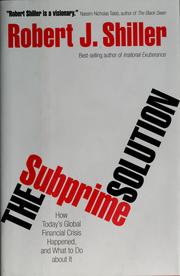
The Subprime Solution
Summary
Robert Shiller wrote this in early 2008, as the mortgage crisis was developing, and it is both a diagnosis and a proposal. His diagnosis is that the housing bubble was a social phenomenon driven by a shared story about house prices, not a failure of any particular institution.
His argument is that a widely held belief that house prices always rise became self-confirming for a period, that this belief spread through media and through observation of neighbours rather than through any analysis, and that the financial instruments built on top of it were consequences rather than causes. He supports this with his own survey data on homebuyer expectations and with the long-run house price series he constructed with Karl Case, which shows real prices roughly flat over a century before the 2000s.
His proposals divide into short-term and long-term. In the short term he favours mortgage modification with a mechanism that avoids case-by-case renegotiation. In the long term he wants what he calls the democratisation of finance: continuous workout mortgages whose payments adjust automatically to the borrower's income and to local house prices, so that renegotiation is built into the contract; home equity insurance; markets in house price indices allowing homeowners to hedge; better financial advice available to ordinary people; improved financial information infrastructure; and new units of account indexed to inflation. Shiller's proposals have largely not been adopted, and the practical obstacles, including basis risk and adverse selection, are addressed only briefly. The diagnosis is more persuasive than the prescription.
Key takeaways 7
- The housing bubble was driven by a shared belief that house prices always rise, which became self-confirming for a period.
- Real American house prices were roughly flat over the century before the 2000s, which contradicted the belief the bubble rested on.
- Financial instruments built on the bubble were consequences of the belief rather than causes of it.
- Continuous workout mortgages would adjust payments automatically to income and local prices, removing the need for case-by-case renegotiation.
- Homeowners cannot hedge house price exposure, which is the largest unhedged position most households hold.
- Shiller argues that financial innovation should be expanded to serve households rather than restricted after each crisis.
- The practical obstacles to his proposals, including basis risk and adverse selection, are addressed only briefly.
Who should read it
Investors and policy readers who want the behavioural diagnosis of the housing bubble and a specific programme for what household finance could look like instead.
About Robert J. Shiller
Sterling Professor of Economics Emeritus, Yale University; co-creator of the Case-Shiller home price indices; Nobel laureate in economics 2013
Excess-volatility work and Irrational Exuberance are the primary sources for the empirical case that asset prices move far more than fundamentals justify.
Where it sits in the reference 2
Similar books 6
Chosen by shared topics, the entries that hold them, and the people who recommended both.