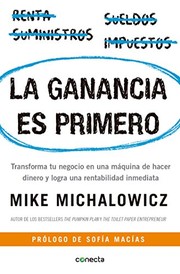
Profit First
Cash discipline for small businesses; a system, not an accounting theory.
Summary
Michalowicz proposes reversing the standard accounting formula. Instead of sales minus expenses equals profit, he argues small business owners should take profit first and operate on what remains, on the argument that expenses expand to consume whatever is available.
The mechanism is a set of bank accounts. Revenue arrives in an income account and is distributed on a fixed schedule, usually twice monthly, into separate accounts for profit, owner's compensation, tax and operating expenses, at predetermined percentages. The operating account is the only one the business spends from, which means the constraint is visible and enforced by the account balance rather than by discipline.
He gives target allocation percentages that vary by revenue level, and a method for moving from current allocations toward the targets gradually rather than immediately, since an immediate change would make the business insolvent. His argument for why this works is behavioural rather than financial. Parkinson's law means expenses expand to fill available funds, and the primacy effect means whatever is deducted first is treated as unavailable. Physically separating the money removes the decision.
He also covers the quarterly profit distribution, which he insists must actually be taken by the owner rather than reinvested, on the argument that a business that never distributes profit is not profitable in any meaningful sense. The method is a budgeting envelope system applied to a business, which is not novel. It fits small owner-operated businesses with simple cash flows and fits poorly where working capital cycles are long or where growth requires reinvestment. The insight that expenses expand to available funds is correct and the mechanism enforces it without requiring discipline.
Key takeaways 8
- Profit should be taken first and the business operated on what remains, rather than treating profit as what is left over.
- Expenses expand to consume whatever funds are available, which is why a business with growing revenue frequently remains unprofitable.
- Physically separating money into different accounts removes the decision, which works where discipline does not.
- The operating account balance becomes the visible constraint, which forces expense decisions that a profit and loss statement does not.
- Allocation percentages should move toward targets gradually, since an immediate change would make most businesses insolvent.
- Quarterly profit must actually be distributed to the owner rather than reinvested, or the business is not profitable in any meaningful sense.
- Tax should be set aside at the point revenue arrives rather than found when the liability falls due.
- The method fits small owner-operated businesses with simple cash flows and fits poorly where working capital cycles are long.
Who should read it
Owners of small businesses with revenue but no profit who need a mechanism rather than a budgeting principle.
Where it sits in the reference 2
Who recommended it 3 · 1 direct
Similar books 6
Chosen by shared topics, the entries that hold them, and the people who recommended both.