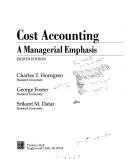
Cost Accounting: A Managerial Emphasis
The standard text; still in print sixty years on.
Summary
Horngren's text is the standard cost and management accounting textbook, in continuous revision since 1962 and now with Datar and Rajan as co-authors.
The organising principle, stated in the title, is that cost information exists to support management decisions rather than to satisfy external reporting, and the book treats different decisions as requiring different cost constructions. The recurring theme is that there is no single correct cost for anything: the relevant cost depends on the decision being made.
The coverage runs from cost terminology and behaviour, through job and process costing, to activity-based costing, budgeting and variance analysis, and then to the decision applications: cost-volume-profit analysis, relevant costs for pricing, make or buy, product mix under constraints, and capital investment. Later sections cover transfer pricing between divisions and the incentive distortions it creates, performance measurement including return on investment and residual income, quality and time as cost drivers, inventory management, and the balanced scorecard.
The most practically important material is the distinction between relevant and irrelevant costs. Sunk costs, allocated fixed overheads and past expenditure are irrelevant to a forward decision, and the book demonstrates repeatedly that including them produces wrong answers on outsourcing, on product discontinuation and on pricing.
The variance analysis material teaches how to decompose a difference between planned and actual results into price, quantity, mix and volume components, which is the standard method for locating where performance diverged.
The book is a teaching text and does not argue a position. It is long, expensive, revised frequently with limited substantive change between editions, and oriented toward manufacturing settings more than toward service or software businesses. It remains the reference for the subject.
Key takeaways 7
- There is no single correct cost for a product, because the relevant cost depends on the decision being made.
- Sunk costs and allocated fixed overheads are irrelevant to forward decisions, and including them produces wrong answers on outsourcing and pricing.
- Variance analysis decomposes the difference between plan and actual into price, quantity, mix and volume components.
- Contribution margin rather than full cost determines the correct product mix when a resource is constrained.
- Transfer pricing between divisions creates incentive distortions that no pricing rule fully eliminates.
- Return on investment as a divisional measure discourages investment in projects that would benefit the firm but lower the division's ratio.
- Cost systems built for external reporting produce numbers that mislead managers making operating decisions.
Who should read it
Anyone who needs to construct or interpret cost information for operating decisions, and finance staff building management reporting.
Where it sits in the reference 2
Similar books 6
Chosen by shared topics, the entries that hold them, and the people who recommended both.