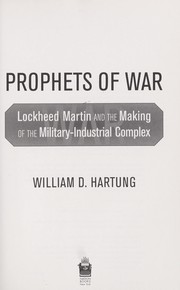
Prophets of War
Lockheed Martin as a case study in the contractor-state relationship.
Summary
William Hartung, an arms control researcher, wrote this history of Lockheed Martin as a study of how the largest American defence contractor operates and how it has shaped the policy that buys from it. The narrative runs from the company's origins through the major programmes to the F-35.
The episodes he covers include the C-5A transport, whose cost overrun was disclosed by analyst Ernest Fitzgerald, who was then dismissed; the 1971 federal loan guarantee that rescued the company after the L-1011 programme and the Rolls-Royce failure; the foreign bribery scandals of the 1970s involving payments in Japan, the Netherlands, Italy and elsewhere, which produced the Foreign Corrupt Practices Act; the consolidation of the defence industry in the 1990s under Pentagon encouragement, including the merger with Martin Marietta and government payment of the resulting restructuring costs; and the F-35 programme, whose development the book treats as structurally protected by its distribution of subcontracts across congressional districts.
Hartung's argument is that the company's core competence is political rather than technical: managing the requirement, the budget process and the congressional coalition. He is a critic writing from an arms control position, and the book gives little space to the company's genuine engineering achievements or to the argument that defence procurement's problems originate in government rather than in contractors. The documentation of specific programmes and of lobbying practice is well sourced.
Key takeaways 7
- Lockheed's defining capability is management of the political and budgetary process rather than of engineering programmes.
- Distributing subcontracts across many congressional districts makes a programme politically difficult to cancel regardless of performance.
- The 1971 federal loan guarantee established that the largest defence contractors would not be permitted to fail.
- Foreign bribery by American aerospace firms in the 1970s produced the Foreign Corrupt Practices Act.
- Defence industry consolidation in the 1990s was encouraged by the Pentagon, which also paid the restructuring costs.
- Cost-plus contracting removes the contractor's exposure to overruns and therefore removes the incentive to control them.
- Hartung argues that former officials moving to contractor employment shapes requirements before any contract is competed.
Who should read it
Investors in defence contractors and analysts of procurement who want a critical history of how the largest player manages its political environment.
Where it sits in the reference 2
Similar books 6
Chosen by shared topics, the entries that hold them, and the people who recommended both.