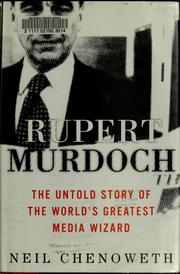
Rupert Murdoch: The Untold Story of the World's Greatest Media Wizard
The financial engineering behind News Corp, traced by a forensic reporter.
Summary
Neil Chenoweth, an Australian financial journalist, examines Rupert Murdoch's business as a financial structure rather than as a media empire. His interest is in how News Corporation was assembled, financed and taxed.
The financial material is the book's distinctive content. Chenoweth traces the corporate structure across jurisdictions, the use of Australian accounting standards that permitted asset revaluations unavailable elsewhere, the effective tax rates achieved through the group's structure, and the debt refinancing crisis of 1990 in which the company came close to failure over a comparatively small loan from a Pittsburgh bank. He examines specific transactions, including the acquisition of Twentieth Century Fox, the launch of the Fox network, and the establishment of BSkyB and its merger with British Satellite Broadcasting.
The book also covers the family and the political relationships, and Chenoweth's argument throughout is that Murdoch's advantage lay in financial engineering and in an appetite for leverage his competitors would not match, rather than in editorial or programming skill. He is a critic, and the reporting is unauthorised. Published in 2001, it precedes the acquisition of Dow Jones, the phone hacking scandal, the split of the company and the Disney transaction. The financial analysis is its lasting value and it is more technical than most books on the subject.
Key takeaways 7
- News Corporation's Australian domicile permitted asset revaluations that raised reported equity and supported further borrowing.
- Murdoch's competitive advantage came from willingness to carry leverage his competitors would not, rather than from media judgement.
- The 1990 refinancing crisis nearly destroyed the company over a small loan that a single lender declined to roll.
- The group's cross-jurisdictional structure produced effective tax rates far below the statutory rates in its operating countries.
- Launching the Fox network required acquiring both a studio and station groups, since neither alone would have been sufficient.
- Chenoweth argues that News Corporation's accounts were constructed to support borrowing rather than to inform shareholders.
- Satellite television required absorbing losses for years, which only an owner with permanent control could sustain.
Who should read it
Investors interested in how a media group was built through leverage, cross-border structuring and accounting choices rather than through content.
Where it sits in the reference 2
Similar books 6
Chosen by shared topics, the entries that hold them, and the people who recommended both.