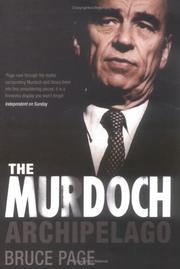
The Murdoch Archipelago
Structural argument about how the papers trade coverage for political favour.
Summary
Bruce Page, formerly of the Sunday Times Insight team and editor of the New Statesman, wrote this as a sustained argument that Rupert Murdoch's business rests on the exchange of political support for regulatory and commercial advantage.
His thesis is specific. Page argues that Murdoch's newspapers and broadcasters do not primarily seek profit through journalism but function as instruments for obtaining favourable decisions from governments, and that the pattern is visible across Australia, Britain and the United States. He documents the specific cases: Australian media ownership rules and their adjustment, the acquisition of the Times and Sunday Times in Britain without referral to the Monopolies and Mergers Commission, the launch of Sky and the regulatory treatment of satellite broadcasting, the American citizenship taken to permit television station ownership, and the relationships with successive political leaders.
Page also argues that Murdoch's operations damage journalism as an institution, and he contrasts them with what he considers proper newspaper practice. The book is hostile throughout and Page makes no attempt at balance; he is a professional opponent writing about a subject he regards as a menace. Readers should weigh that. The documentation of specific regulatory decisions and their political context is well researched. It was published in 2003, before the phone hacking scandal that supplied its strongest evidence.
Key takeaways 7
- Page argues that Murdoch's media assets function to obtain regulatory decisions rather than primarily to earn returns from journalism.
- The acquisition of the Times and Sunday Times proceeded without referral to competition authorities, which Page treats as the pattern's clearest case.
- Murdoch took American citizenship because United States law restricted foreign ownership of television stations.
- Regulatory treatment of satellite broadcasting in Britain determined Sky's viability and was politically influenced.
- Political leaders across three countries sought Murdoch's support and adjusted media policy accordingly.
- Page writes as a professional opponent and makes no attempt at balance, which readers should weigh throughout.
- The book predates the phone hacking scandal, which supplied the strongest evidence for its thesis.
Who should read it
Readers who want the sustained hostile case against Murdoch's business model, understood as advocacy rather than assessment.
Where it sits in the reference 2
Similar books 6
Chosen by shared topics, the entries that hold them, and the people who recommended both.