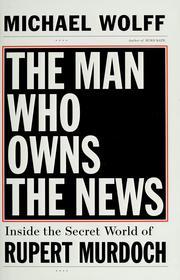
The Man Who Owns the News
Fifty hours of interviews plus the family; the closest to authorised.
Summary
Michael Wolff obtained extended access to Rupert Murdoch during the period around the acquisition of Dow Jones and the Wall Street Journal in 2007, and wrote this biography from many hours of interviews with him and with his family.
The book's centre is the Dow Jones transaction: how Murdoch pursued it, how the Bancroft family that controlled Dow Jones was persuaded to sell, and what the acquisition meant to Murdoch personally. Wolff uses it to examine how Murdoch operates, arguing that his method is patience combined with an understanding of family-controlled businesses and their internal divisions, and that he had been preparing this particular acquisition for decades.
The family material covers the succession question in detail: the relationships among Murdoch's children, the trust structure that determines control, the position of his then wife Wendi Deng and their daughters, and the internal competition. Wolff writes as a stylist with a tendency to psychological interpretation, and his access came with the reputational risks that Murdoch presumably understood. The book was published in 2008, before the phone hacking scandal, the company split, the Disney transaction and the succession resolution, all of which change how the story reads. Its account of how family-controlled media businesses are acquired is the most transferable content.
Key takeaways 7
- Murdoch's method with family-controlled businesses is patience combined with exploiting the internal divisions such families develop.
- The Bancroft family's dispersed ownership meant that persuading a sufficient number of individual holders was easier than persuading the family.
- Murdoch pursued the Wall Street Journal for decades before the conditions permitted the acquisition.
- Control of News Corporation rests on a trust structure whose terms determine the succession regardless of family preferences.
- Wolff argues that Murdoch's acquisitions have been driven by personal and political interest more than by financial return.
- Family-controlled media businesses become vulnerable when later generations hold shares without operating involvement.
- The book predates the phone hacking scandal and the company's subsequent restructuring, which changes how its judgements read.
Who should read it
Investors and operators interested in how family-controlled businesses are acquired and in the succession dynamics of a controlled media group.
Where it sits in the reference 2
Similar books 6
Chosen by shared topics, the entries that hold them, and the people who recommended both.