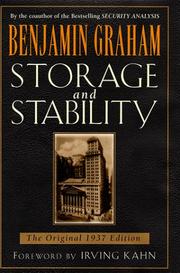
Storage and Stability
Subtitled A Modern Ever-Normal Granary; commodity-reserve currency plan.
Summary
Graham wrote this in 1937 proposing a commodity reserve currency, in which a country's currency would be backed by a fixed basket of storable raw materials rather than by gold alone.
The mechanism he proposes works in both directions. The government would stand ready to buy the defined basket at a fixed price and to sell it at a slightly higher one, which puts a floor under commodity prices during gluts and a ceiling during shortages. Because the government buys when prices are low and sells when they are high, it accumulates reserves during depressions, which injects money precisely when demand has collapsed, and releases them during booms, which withdraws money when the economy is overheating. The scheme is therefore counter-cyclical monetary policy and a strategic reserve simultaneously.
His argument for it was written in the context of the 1930s, when agricultural and commodity surpluses coexisted with unemployment and hunger, and he treats that coexistence as evidence of a monetary rather than a productive failure.
Graham pursued this proposal for decades and it was taken seriously by Keynes, Friedman and others without being adopted. Its problems are practical: selecting and weighting the basket, the storage costs of the commodities involved, the perishability of several candidates, and the international coordination the scheme would require.
The book is of interest today as a monetary proposal from the person best known for security analysis, and because the counter-cyclical buffer stock logic recurs in strategic reserve and price stabilisation debates.
Key takeaways 7
- A currency could be backed by a fixed basket of storable commodities rather than by gold, with the government standing ready to buy and sell the basket at fixed prices.
- Such a scheme is automatically counter-cyclical, since the government accumulates reserves and injects money when prices are low and releases them when prices are high.
- Buffer stock accumulation during a depression puts a floor under commodity prices and supplies money at the moment demand has collapsed.
- Simultaneous commodity surpluses and human deprivation indicate a monetary and distributive failure rather than a failure of production.
- A commodity-backed currency ties money to things people actually consume rather than to a metal with limited industrial use.
- The practical obstacles are basket selection and weighting, storage cost, perishability and the international coordination required.
- Graham pursued this proposal for decades and it was engaged with seriously by leading economists without ever being adopted.
Who should read it
Readers interested in monetary proposals and buffer stock schemes, and in the economic work of the person known for security analysis.
About Benjamin Graham
Co-founder, Graham-Newman Corporation; lecturer in finance, Columbia Business School 1928-1956
Security Analysis and The Intelligent Investor are the founding texts of value investing and remain the primary source every later value investor argues from.
Where it sits in the reference 2
Who recommended it 1 · 1 direct
Similar books 6
Chosen by shared topics, the entries that hold them, and the people who recommended both.