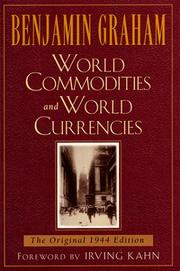
World Commodities and World Currency
Summary
Graham published this in 1944, during the discussions that produced the Bretton Woods system, to propose a monetary arrangement based on a basket of storable commodities rather than on gold alone. It extends the argument he first made in Storage and Stability in 1937.
The proposal is specific. A monetary authority would define a unit of currency as a fixed quantity of a composite bundle of raw commodities, for example wheat, cotton, copper, rubber and other storable staples in fixed proportions. It would stand ready to buy the bundle when its market price fell below the defined value and to sell when it rose above, exactly as a gold standard authority buys and sells gold. Graham argued this would achieve three things at once: it would stabilise the general price level of raw materials, it would create a buffer stock that smoothed commodity supply between good and bad harvests, and it would give the currency a backing tied to goods people actually use rather than to a metal with little industrial demand.
He addressed the objections he anticipated, including storage costs, the selection and revision of the bundle, and the risk that the scheme would become a price support programme for producers.
The proposal was not adopted. Bretton Woods used dollar convertibility into gold, and the later system uses no commodity anchor at all. Economists including Keynes engaged with the idea seriously at the time, and Hayek discussed a related scheme. The practical objections are substantial: storage and spoilage costs are real, the composition of a representative bundle changes as economies change, and the arrangement would tie monetary policy to commodity markets whose own dynamics are unstable. The book is of interest mainly as an unfamiliar part of Graham's work and as a serious pre-Bretton Woods alternative that lost.
Key takeaways 7
- A currency can be defined in terms of a basket of storable commodities rather than in terms of a single metal.
- A monetary authority buying and selling the commodity bundle at a fixed price would stabilise raw material prices automatically.
- The same operation creates a buffer stock, so monetary stabilisation and commodity supply smoothing can be achieved with one mechanism.
- Gold is a poor monetary anchor because its supply bears no relation to the goods an economy actually produces and consumes.
- Commodity price instability transmits into general economic instability, so stabilising it addresses a cause rather than a symptom.
- Storage costs and the changing composition of a representative bundle are the practical objections the scheme must answer.
- Graham argued that the scheme would operate automatically without discretionary judgement, which he regarded as its main advantage over managed currency.
Who should read it
Readers interested in monetary system design and in the alternatives considered before Bretton Woods, or in the parts of Graham's thinking outside security analysis.
About Benjamin Graham
Co-founder, Graham-Newman Corporation; lecturer in finance, Columbia Business School 1928-1956
Security Analysis and The Intelligent Investor are the founding texts of value investing and remain the primary source every later value investor argues from.
Where it sits in the reference 2
Who recommended it 1 · 1 direct
Similar books 6
Chosen by shared topics, the entries that hold them, and the people who recommended both.