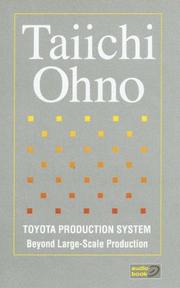
Taiichi Ohno's Workplace Management
Insider account: Ohno's shorter, blunter shop-floor essays.
Summary
Taiichi Ohno created the Toyota Production System, and this book collects his own statements about it in a form closer to spoken instruction than to a treatise. The English translation appeared decades after the Japanese original and reads as a series of short chapters, each making one point.
Ohno's positions are frequently uncomfortable. He insists that managers must observe the work directly and at length, and describes making engineers stand in a circle on the shop floor for hours until they saw what was actually happening. He argues that averages conceal everything that matters, that data should be distrusted in favour of facts observed personally, and that the words of the person doing the work are more reliable than any report. He explains asking why five times to reach the cause of a problem rather than its symptom, and gives the worked example of a machine failure traced back to a missing filter.
On the production system itself he covers standard work as the baseline against which improvement is measured rather than as a fixed procedure, the deliberate creation of problems by reducing inventory so that they become visible, the andon cord that lets any worker stop the line, and the reversal of conventional thinking about production quantity. He is explicit that the system exists to reduce cost by eliminating waste, and that everything else follows. The book is short and repetitive and the translation is uneven. It is the primary source for ideas that most lean literature restates.
Key takeaways 7
- Managers must observe the work directly and at length, because reports and data conceal what is actually happening.
- Asking why five times reaches the cause of a problem, and stopping earlier addresses a symptom.
- Averages conceal the variation that causes problems, so working from averaged data prevents improvement.
- Standard work is the current best-known method and the baseline against which improvement is measured, not a fixed procedure.
- Reducing inventory deliberately makes problems visible that inventory had been concealing.
- Any worker must be able to stop the production line, because a defect passed downstream costs more than the stoppage.
- Ohno argues that the purpose of the entire system is cost reduction through the elimination of waste, and that other framings miss the point.
Who should read it
Operators implementing lean methods who want the founder's own uncompromising statements rather than the consultant literature derived from them.
Where it sits in the reference 2
Similar books 6
Chosen by shared topics, the entries that hold them, and the people who recommended both.