Toyota Under Fire
The recall crisis and tsunami tested against the lean model.
Summary
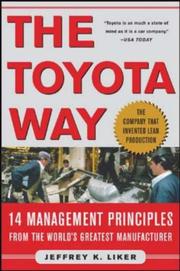
Jeffrey Liker, who wrote The Toyota Way, and Timothy Ogden examine Toyota's response to the crisis of 2009 and 2010, when the company recalled millions of vehicles over unintended acceleration and faced congressional hearings and enormous reputational damage.
Their account of the technical question follows the investigations, including the National Highway Traffic Safety Administration study conducted with NASA, which found floor mat entrapment and sticky accelerator pedals as causes and found no electronic cause for unintended acceleration. They argue that the media narrative substantially outran the evidence and that a large share of reported incidents were pedal misapplication by drivers.
Their management argument is that Toyota's real failure was that growth had outpaced its ability to develop people. The company had expanded rapidly through the 2000s, opening plants and hiring faster than it could transmit its methods, and the quality and responsiveness problems followed from that rather than from any abandonment of principle. They also cover the 2008 financial crisis, in which Toyota posted its first operating loss in decades and did not lay off permanent employees, and the 2011 earthquake response. Liker has a long professional association with Toyota and the book is sympathetic; readers should weigh that against the account. The argument about growth outpacing capability transmission is the transferable content.
Key takeaways 7
- Official investigations found floor mat entrapment and pedal mechanics as causes and found no electronic cause for unintended acceleration.
- The authors argue that Toyota's real failure was expanding faster than it could transmit its methods to new plants and people.
- A management system that depends on developed people cannot be scaled faster than people can be developed.
- Toyota's initial response to the crisis was slow and technically framed, which failed as a public response regardless of its accuracy.
- The company avoided laying off permanent employees during its first operating loss in decades, which the authors treat as consistent with its principles.
- Liker has a long professional association with Toyota and the account is sympathetic throughout.
- Reported incident data in a public safety controversy is shaped by the publicity itself, which complicates any technical assessment.
Who should read it
Operators scaling an organisation whose advantage depends on developed capability, and readers assessing how a quality-based company handled a public crisis.
Where it sits in the reference 2
Similar books 6
Chosen by shared topics, the entries that hold them, and the people who recommended both.