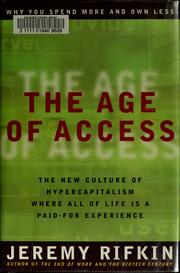
The Age of Access
Early and prescient case that access would displace ownership.
Summary
Jeremy Rifkin argued in 2000 that capitalism was shifting from the exchange of property to the granting of access, and that this change would transform both commerce and social life. Written at the peak of the first internet boom, the book anticipates several developments accurately and several not at all.
His central claim is that ownership is becoming less important than access to networks, and that markets are giving way to networks as the organising structure of commerce. Firms outsource physical assets and retain relationships; consumers subscribe rather than buy; suppliers become partners in continuous relationships rather than counterparties in discrete transactions. He predicted the growth of leasing and subscription across categories, the importance of the customer relationship over the product, and the shift of value toward intangibles and brands.
The second half concerns culture. Rifkin argues that commercial networks are absorbing the cultural sphere, so that experiences previously produced through community and shared life become purchased services, and that this depletes the social capital on which commerce itself depends. He treats this as the more important development and it is where his argument is weakest, since it depends on assertions about cultural depletion that he does not evidence. The subscription and access predictions were substantially correct and arrived earlier and more completely than most contemporaneous forecasts. Rifkin writes at length and repeats himself.
Key takeaways 7
- Access to a continuing service is displacing ownership of a discrete product across an expanding range of categories.
- Firms increasingly retain customer relationships and intangibles while outsourcing physical assets.
- Subscription relationships convert one-time transactions into continuing revenue and shift the basis of competition to retention.
- Rifkin argues that value has moved from the production of goods to the management of relationships and experiences.
- Networks rather than markets become the organising structure when transactions are continuous rather than discrete.
- Commercial provision of experiences previously produced through community depletes the social capital that commerce relies on.
- The cultural argument rests on assertions about social depletion that the book does not evidence.
Who should read it
Operators building subscription and access businesses who want an early and largely accurate account of the shift, with its cultural chapters read sceptically.
Where it sits in the reference 2
Similar books 6
Chosen by shared topics, the entries that hold them, and the people who recommended both.