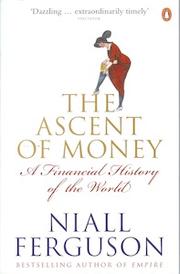
The Ascent of Money
Niall Ferguson's history of financial innovation — from Medici banking to mortgage-backed securities. Adds a dimension the other books underweight: capital markets, insurance, and credit are not peripheral to economic development but central to it. Readable but should be checked against critics of Ferguson's selective history.
Summary
Ferguson writes a history of finance organised by instrument rather than by chronology, covering money and credit, bonds, equities, insurance, real estate and international capital flows, with each chapter tracing an instrument from its origin to the present.
The credit chapter covers Mesopotamian lending, medieval Italian banking and the Medici, and the development of fractional reserve banking. The bond chapter covers the Italian city states, the financing of European wars, the Rothschilds, and the argument that bond markets discipline governments. The equity chapter covers the Dutch East India Company, the Mississippi Company and John Law, and the modern joint stock corporation. The insurance chapter covers the Scottish widows fund, actuarial science, the welfare state as socialised insurance, and Chile's pension reform. The real estate chapter covers the Anglo-American property-owning ideology and the subprime crisis. The final chapter covers what Ferguson calls Chimerica, the mutual dependence between Chinese saving and American consumption.
His central argument is that financial innovation has been a cause of prosperity rather than a parasite on it, and that most public hostility to finance rests on misunderstanding what the instruments do.
The book was written just as the 2008 crisis broke, which affects its confidence in places. Ferguson is a conservative historian with political commitments that shape the treatment, and his defence of financial innovation gives limited weight to the crises he himself documents. The coverage is broad rather than deep and specialists find each chapter thin. It works as a survey of how each instrument came to exist and what problem it was invented to solve.
Key takeaways 8
- Credit and lending predate coinage, and the earliest financial records are debt contracts rather than records of exchange.
- Bond markets discipline governments by pricing the risk of default, which historically constrained rulers more effectively than any political mechanism.
- The joint stock company allowed capital to be raised from strangers by limiting liability and making ownership transferable.
- Insurance converts unpredictable individual catastrophe into a predictable collective cost, and the welfare state applies the same mechanism through the government.
- The property-owning ideology in English-speaking countries was a deliberate political project rather than a natural preference.
- Financial crises recur because the instruments that spread risk also conceal where it has accumulated.
- Chinese saving funding American consumption created a mutual dependence that Ferguson identified as unstable before the imbalance was widely discussed.
- Ferguson defends financial innovation as a cause of prosperity while giving limited weight to the crises documented in his own chapters.
Who should read it
Readers who want a survey of how each major financial instrument originated and what problem it solved, treating the political framing as one position.
About Niall Ferguson
Historian and senior fellow at the Hoover Institution, Stanford; previously taught at Oxford, Harvard and NYU Stern.
The Ascent of Money traces credit, bond markets, joint-stock equity, insurance and property finance from their origins, giving investors the institutional history behind instruments they price every day. The House of Rothschild and High Financier examine how two banking houses actually made money and managed sovereign and political risk over long periods.
Where it sits in the reference 3
Who recommended it 5 · 1 direct
Similar books 6
Chosen by shared topics, the entries that hold them, and the people who recommended both.