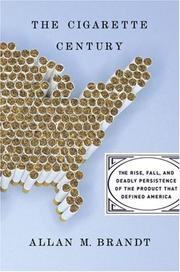
The Cigarette Century
The regulatory and litigation environment that set what the tobacco assets were worth.
Summary
Brandt, a historian of medicine at Harvard, wrote a history of the cigarette in twentieth-century America, covering its rise from a marginal product to a mass consumer good, the establishment of its health effects, and the industry's response.
The first part explains how the cigarette was created as a product and as a cultural object. Machine manufacture made mass production possible, and advertising made the product desirable, associating it with modernity, independence and later with women's emancipation through campaigns Edward Bernays designed. Wartime distribution to soldiers established the habit across a generation. Brandt argues the cigarette is the paradigm case of a product whose demand was manufactured rather than discovered.
The second part covers the science. Epidemiological studies in the late 1940s and 1950s, particularly Doll and Hill in Britain and Wynder and Graham in the United States, established the association, and the causal inference criteria developed to interpret them became a foundation of modern epidemiology.
The third part is the industry's response, which Brandt documents from the internal papers released through litigation. The 1953 meeting at the Plaza Hotel produced a coordinated strategy of funding research designed to sustain the appearance of controversy, of publicly demanding proof while privately accepting the findings, and of framing smoking as a matter of individual choice. Brandt argues this created a template that later industries copied for other products and for climate science.
The final part covers litigation, the Master Settlement Agreement, regulation, and the industry's shift to markets outside the United States.
The book is long and academic. Brandt served as an expert witness in tobacco litigation, which he discloses and which readers should weigh, though the documentary record he draws on is public.
Key takeaways 7
- Cigarette demand was manufactured through advertising and wartime distribution rather than discovered in existing consumer preference.
- The epidemiological studies of the 1950s established the causal link and produced the inference criteria that modern epidemiology still uses.
- The industry coordinated in 1953 on a strategy of funding research to sustain the appearance of scientific controversy.
- Executives publicly demanded proof of harm while internal documents show they accepted the findings.
- Framing smoking as individual choice shifted responsibility to consumers and delayed regulation for decades.
- The manufactured-doubt strategy developed for tobacco became a template later applied to other products and to climate science.
- Litigation discovery rather than regulation or journalism produced the documents that established what the industry knew.
Who should read it
Operators and investors in regulated consumer categories who want the documented history of how an industry managed scientific evidence against its product.
Where it sits in the reference 3
Similar books 6
Chosen by shared topics, the entries that hold them, and the people who recommended both.