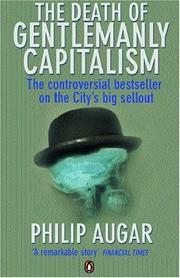
The Death of Gentlemanly Capitalism
How Big Bang handed the City's investment banks to foreign owners.
Summary
Augar, a former head of equities at Schroders, explains why every significant British investment bank was sold to a foreign owner within a decade of the 1986 Big Bang deregulation.
His explanation is structural rather than cultural. Big Bang removed fixed commissions and the separation between brokers and jobbers, which allowed integrated firms to compete on capital. British merchant banks and brokers were small, thinly capitalised partnerships and family firms whose competitive advantage was relationships within a closed City. When the market opened, competition shifted to balance sheet capacity, distribution reach and research scale, and American firms had far more of all three. British firms also paid enormous prices to acquire brokers and jobbers in the run-up to Big Bang, which consumed the capital they would have needed to compete afterward.
Augar covers the specific failures: Barings destroyed by a single trader, Warburg sold to Swiss Bank Corporation, Kleinwort Benson to Dresdner, Schroders to Citigroup, and the others in sequence. He argues management was a genuine factor, since the British firms were run by people whose skills were in client relationships rather than in managing capital and risk, and that the partnership cultures could not adapt to the compensation and risk structures the new competition required.
The book is a well-informed insider account and is the standard work on the subject. It is written from a British perspective with some regret about what was lost, and readers should weigh that. It ends in 2000 and its sequel covers the subsequent period.
Key takeaways 7
- Big Bang shifted competition in the City from relationships to balance sheet capacity, distribution reach and research scale, on all of which British firms were far behind.
- British firms paid very high prices acquiring brokers and jobbers before Big Bang, which consumed the capital they needed to compete after it.
- Thinly capitalised partnerships could not compete against firms whose capital allowed them to take principal positions and to underwrite at scale.
- British investment bank management came from client relationship backgrounds and lacked experience managing trading risk and capital.
- Partnership cultures could not adopt the compensation structures required to retain staff against American competitors.
- Deregulation intended to strengthen the City's position transferred its institutions to foreign ownership within a decade while preserving London as a location.
- Domestic ownership of financial institutions and the health of a financial centre are separable, and Britain retained one while losing the other.
Who should read it
Finance professionals interested in how deregulation changes the basis of competition and eliminates incumbents whose advantage was relational.
About Philip Augar
Former investment banker at Schroders and NatWest Markets who writes on the British investment banking industry.
The Death of Gentlemanly Capitalism explains why British merchant banks sold themselves to American and European buyers after Big Bang, and what their owners misjudged about the capital intensity of the business they were in. The Greed Merchants and The Bank That Lived a Little examine fee structures and client conflicts inside integrated investment banks, the second through Barclays' decision to buy Lehman's American operations.
Where it sits in the reference 4
Similar books 6
Chosen by shared topics, the entries that hold them, and the people who recommended both.