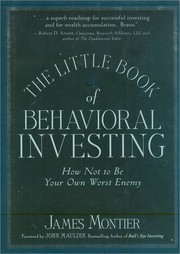
The Little Book of Behavioral Investing
Practical countermeasures rather than a catalogue of biases.
Summary
Montier, a strategist who has worked at Dresdner Kleinwort, Societe Generale and GMO, condensed the behavioural finance literature into short chapters aimed at practitioners. Each chapter names a bias, cites the underlying experiment or market study, and proposes a change to investment process.
The biases covered include overoptimism, illusion of control, overconfidence in forecasts, confirmation bias, conservatism in updating, anchoring, the tendency to act under stress, herding, loss aversion and the sunk cost effect. Montier's practical recommendations follow a single principle: since biases cannot be reasoned away in the moment, investors should change their process in advance. He argues for pre-committed buy and sell criteria written when unemotional, for checklists, for reading company accounts before reading the story, for ignoring macroeconomic forecasts entirely, and for deliberately seeking evidence that contradicts an existing position.
His strongest empirical claims concern forecasting. He presents data showing that analyst earnings forecasts and economist growth forecasts have close to no predictive value, and that both groups adjust after events rather than before them.
The book repeats material from Montier's research notes and from Behavioural Investing, his longer academic-facing volume. It is thin on the question of whether knowing about a bias reduces it, and the replication problems that have hit parts of social psychology since 2011 touch some of the studies he cites, though the finance-specific findings on forecasting and overconfidence have held up better.
Key takeaways 7
- Analyst and economist forecasts have essentially no predictive value, so any process depending on them is unsound.
- Biases cannot be corrected by awareness in the moment, so investors must pre-commit to rules while calm.
- Investors should read a company's financial statements before reading its narrative, because the story anchors the numbers.
- Doing nothing is usually the correct action, and the pressure to act destroys returns.
- Overconfidence rises with the amount of information collected while accuracy does not.
- A written checklist reduces error more effectively than experience or intelligence.
- Investors should decide in advance what evidence would prove them wrong and then look for it.
Who should read it
Investors and analysts who want behavioural findings translated into specific process rules they can put in place before the next drawdown.
Where it sits in the reference 2
Who recommended it 1 · 1 direct
Similar books 6
Chosen by shared topics, the entries that hold them, and the people who recommended both.