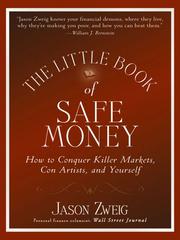
The Little Book of Safe Money
Summary
Zweig, a financial journalist and later the editor of the revised Intelligent Investor, wrote this in the aftermath of 2008 to argue that most products sold as safe are not. His method is to take each supposedly conservative choice and examine how it actually behaved when stressed.
He covers money market funds that broke the buck, auction rate securities that stopped auctioning, ultra-short bond funds that held mortgage paper, structured notes with principal protection that depended on the issuer's solvency, commodity exchange-traded funds whose returns diverged from spot prices because of futures roll costs, and hedge fund replication products. He also examines annuities, arguing that a plain immediate annuity is useful for guaranteeing lifetime income while variable annuities with riders are usually not worth their fees.
The positive recommendations are conventional and defensible: hold genuine cash in insured deposits or Treasury funds, use Treasury inflation-protected securities for inflation risk, keep costs low, size positions so that a total loss in any one is survivable, and separate the money you cannot afford to lose from the money you can.
The book is a product of its moment and some specifics have aged. Interest rates, annuity pricing and the exchange-traded fund market have all changed substantially since 2009. The general method, which is to ask what a product holds and who bears the loss when it fails, has not.
Key takeaways 7
- Products marketed as cash equivalents frequently hold credit risk that only appears when markets stop functioning.
- Commodity exchange-traded funds track futures curves rather than spot prices, so they can lose money while the commodity rises.
- Principal protection in a structured note is only as good as the credit of the bank that issued it.
- A plain immediate annuity is a defensible way to insure longevity risk, while variable annuities with riders usually are not.
- Reaching for a slightly higher yield in a cash account has repeatedly produced losses far larger than the extra yield.
- Investors should size every position so that losing all of it would not change their life.
- Inflation-protected Treasury securities are the only instrument that directly hedges inflation for a retail investor.
Who should read it
Individual investors and anyone advising them who needs a checklist for interrogating conservative-sounding products before buying them.
About Jason Zweig
Columnist, 'The Intelligent Investor', The Wall Street Journal; previously Money, Time and Forbes
Your Money and Your Brain brought neuroeconomics to a general investing audience, and his annotated edition of Benjamin Graham keeps a canonical text usable for modern readers.
Where it sits in the reference 2
Who recommended it 1 · 1 direct
Similar books 6
Chosen by shared topics, the entries that hold them, and the people who recommended both.