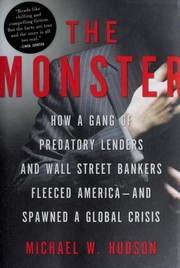
The Monster: How a Gang of Predatory Lenders and Wall Street Bankers Fleeced America
Origination-floor reporting on the subprime lenders Countrywide competed against and copied.
Summary
Michael Hudson, an investigative reporter who covered consumer lending for years before the crisis, traces subprime mortgage lending from its origins in the 1990s through the collapse. Ameriquest and its founder Roland Arnall are the central subject.
The reporting is at ground level. Hudson interviewed loan officers, branch managers and borrowers, and documents the specific sales practices: falsifying income documentation, altering appraisals, misrepresenting loan terms at closing, switching documents at signing, and targeting elderly and minority borrowers with existing home equity. He documents the compensation structure, in which loan officers earned yield spread premiums for placing borrowers in higher-rate loans than they qualified for, and the branch culture that produced the behaviour.
The second thread is the Wall Street funding that made it possible. Hudson shows how investment banks bought these loans, securitised them, and eventually acquired originators outright to secure supply, and how the due diligence firms they engaged found large defect rates in loan pools that were securitised anyway. He also documents the regulatory failures, including the preemption of state consumer protection laws for federally chartered institutions and the political access that Arnall obtained through political donations. The book is angry and one-sided, and Hudson does not engage the argument that many borrowers understood what they were signing. The documentation of origination practices is unmatched.
Key takeaways 7
- Loan officers earned yield spread premiums for placing borrowers in higher-rate loans than they qualified for.
- Hudson documents systematic falsification of income documents, appraisals and closing paperwork at large originators.
- Investment banks acquired originators outright to secure loan supply for their securitisation pipelines.
- Due diligence firms found high defect rates in loan pools that were securitised without disclosure of those findings.
- Federal preemption removed state consumer protection laws from institutions that chose federal charters.
- Subprime lending targeted borrowers with existing home equity rather than borrowers seeking to buy, which made it an extraction rather than a credit expansion.
- Hudson does not engage the argument that many borrowers understood the terms, which is the account's principal gap.
Who should read it
Investors and regulators who want ground-level documentation of subprime origination practices and of how securitisation demand shaped them.
Where it sits in the reference 2
Similar books 6
Chosen by shared topics, the entries that hold them, and the people who recommended both.