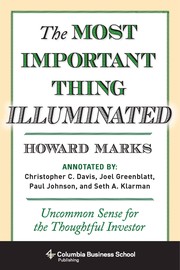
The Most Important Thing: Uncommon Sense for the Thoughtful Investor
Oaktree's founder on risk and second-level thinking in credit.
Summary
Marks distils the arguments from his Oaktree Capital memos into twenty chapters, each named as the most important thing, which is his deliberate joke about the number of things that matter. He writes as a distressed debt investor whose firm was built on buying assets when other people had to sell.
The central framework is second-level thinking. First-level thinking says a company is good so the stock should be bought. Second-level thinking asks what everyone else believes, whether the price already contains that belief, and whether the consensus is wrong. Marks argues that outperformance requires being both non-consensus and correct, and that the first without the second is simply being wrong in public.
His treatment of risk is the strongest material. He argues that risk is the probability of permanent loss rather than volatility, that risk cannot be observed after the fact because outcomes reveal only one path, and that the riskiest thing in markets is the widespread belief that there is no risk. He describes market cycles in terms of the pendulum between greed and fear, and argues that investors can know where they are in a cycle even though they cannot predict its timing.
His positive prescription is defensive investing, meaning that avoiding losers matters more than finding winners, and that most institutional records are made by consistency rather than by brilliance. He is explicit that market timing is impossible and that assessing the current temperature is not. The book is repetitive because the memos were, and it offers no valuation technique or specific method. Its value is in the discipline of thinking about price relative to value and about where a cycle stands, not in any procedure a reader can apply mechanically.
Key takeaways 8
- Outperformance requires second-level thinking, meaning a view that differs from consensus and turns out to be correct.
- Risk means the probability of permanent capital loss and cannot be measured by volatility.
- Risk is highest when investors believe risk is absent, because that belief produces the prices and the behaviour that create the danger.
- Almost no asset is so good that it cannot become overpriced, and almost none so bad that it cannot become cheap enough to buy.
- Cycles cannot be timed but the current position within a cycle can be assessed from observable investor behaviour and pricing.
- Avoiding losses is the reliable route to long-term returns, because a record without disasters compounds while a record with them does not.
- Luck plays a large enough role in any single outcome that decisions must be evaluated on the reasoning available at the time.
- Knowing what you do not know is more useful than any forecast, and investors who accept that they cannot predict macro outcomes make better decisions.
Who should read it
Investors who want a disciplined framework for thinking about price, risk and market cycles rather than a valuation method.
About Howard Marks
Co-founder and Co-Chairman, Oaktree Capital Management
His client memos, written continuously since 1990, are a primary source on risk, cycles and market psychology that other investors quote directly.
Where it sits in the reference 11
Who recommended it 6 · 4 direct
Similar books 6
Chosen by shared topics, the entries that hold them, and the people who recommended both.