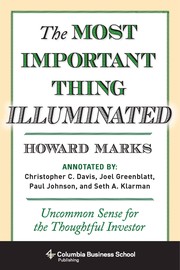
The Most Important Thing Illuminated
Annotated edition of the 2011 book with four commentators.
Summary
This edition adds commentary from four investors to Marks' original text: Christopher Davis, Joel Greenblatt, Paul Johnson and Seth Klarman. Their annotations appear alongside the chapters, sometimes agreeing, sometimes qualifying and occasionally disagreeing with Marks.
The underlying book is unchanged. Marks argues for second-level thinking, meaning holding a view that differs from consensus and turns out to be right; for defining risk as the probability of permanent loss rather than as volatility; for recognising that the riskiest moments are those when investors believe risk is absent; for assessing where a cycle currently stands rather than attempting to predict its turning points; and for defensive investing, where avoiding losses matters more than finding winners.
The commentary adds practical texture. Klarman's notes are the most substantive, particularly on the difficulty of holding a contrarian position when clients are withdrawing capital, and on the institutional constraints that prevent professionals from acting on what they know. Greenblatt adds material on special situations and on the discipline of doing nothing. Davis and Johnson contribute perspective from long-only management and from teaching.
The value over the original edition depends on whether a reader wants those interjections. Some find they break the flow of Marks' argument, others find they show how experienced investors disagree at the margins. Neither version contains a valuation method or a specific procedure, which is deliberate. Both are collections of judgment rather than technique, drawn from Marks' Oaktree memos, which are available free and which some readers prefer in the original form.
Key takeaways 8
- Outperformance requires second-level thinking, meaning a view different from consensus that turns out to be correct.
- Risk means the probability of permanent capital loss and is not captured by any measure of volatility.
- The riskiest environment is the one in which investors believe risk has been eliminated, because that belief creates the pricing and the behaviour that produce danger.
- Where a market sits in its cycle can be assessed from investor behaviour and pricing even though the timing of the turn cannot be predicted.
- Avoiding losses produces long-run returns more reliably than identifying winners, because a record without disasters compounds.
- Institutional constraints, including client withdrawals and benchmark measurement, prevent professionals from acting on views they hold correctly.
- Almost no asset is so good that it cannot be overpriced, and almost none so bad that it cannot become cheap enough to buy.
- Doing nothing is frequently the correct action, and the pressure to act destroys more capital than incorrect analysis does.
Who should read it
Investors who want Marks' framework with four experienced practitioners annotating where they agree and where they qualify it.
About Howard Marks
Co-founder and Co-Chairman, Oaktree Capital Management
His client memos, written continuously since 1990, are a primary source on risk, cycles and market psychology that other investors quote directly.
Where it sits in the reference 4
Who recommended it 5 · 2 direct
Similar books 6
Chosen by shared topics, the entries that hold them, and the people who recommended both.