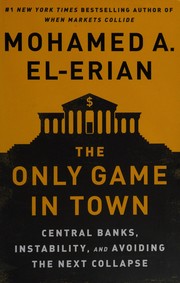
The Only Game in Town
Central banks holding rates down because no other authority will act.
Summary
El-Erian, formerly chief executive of PIMCO, argues that central banks became the only functioning policymakers after 2008 and that this arrangement cannot last. Elected governments failed to act on fiscal policy, structural reform and debt restructuring, so central banks used monetary tools to substitute, first through interest rates and then through asset purchases and forward guidance.
His diagnosis is that these tools can buy time but cannot create growth. They work on financial conditions rather than on productivity, labour markets or the allocation of resources. Meanwhile they produce side effects: asset price inflation, distorted risk pricing, capital misallocation, and pressure on savers and pension funds. He argues that this generated what he calls artificial financial stability sitting on top of unresolved economic problems.
The forecast is structured around what he calls a T junction. The current path is unsustainable and ends within a few years in one of two directions: either governments act, producing higher inclusive growth and reduced financial risk, or the arrangement breaks, producing recession, renewed financial instability and political fragmentation. He assigns the two branches roughly equal probability. He also examines behavioural and organisational obstacles to seeing the transition coming, including cognitive blind spots and institutional inertia.
The timing was wrong. The arrangement he described persisted for years beyond his horizon, and the eventual break in 2020 to 2022 came from a pandemic and fiscal expansion rather than from the mechanisms he identified. The description of central bank overburdening and its side effects has aged better than the forecast.
Key takeaways 7
- Central banks became the only active policymakers because elected governments would not act on fiscal and structural policy.
- Monetary policy influences financial conditions but cannot raise productivity or fix labour market mismatch.
- Prolonged unconventional policy produces artificial financial stability that conceals unresolved real economy problems.
- Asset purchases distort risk pricing and push investors into positions they would not otherwise hold.
- The post-crisis arrangement is unstable and resolves either into higher inclusive growth or into recession and fragmentation.
- Liquidity in many markets has become an illusion, because the intermediaries that once absorbed selling no longer hold inventory.
- Institutions fail to prepare for regime change because their processes are built around extrapolating the current regime.
Who should read it
Allocators and operators who need a clear statement of what central bank policy can and cannot do, and how its side effects show up in asset markets.
Where it sits in the reference 2
Who recommended it 1
Similar books 6
Chosen by shared topics, the entries that hold them, and the people who recommended both.