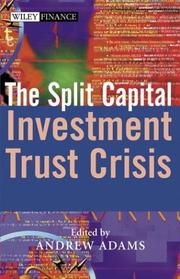
The Split Capital Investment Trust Crisis
The UK trust sector's own blow-up: gearing, cross-holdings and collapse.
Summary
Andrew Adams edited this collection on the collapse of the British split capital investment trust sector between 2001 and 2003, which destroyed the savings of tens of thousands of retail investors.
Split capital trusts issue different classes of share with different claims: zero dividend preference shares receiving a fixed capital sum at wind-up, income shares receiving the dividends, and capital shares receiving the residual. The structure works when the underlying assets perform, and the zero preference shares were marketed to retail investors as low-risk instruments with a predetermined return.
The collection explains what went wrong. Trusts became heavily geared through bank debt, which sat ahead of every share class. And they invested in each other, so that trusts held each other's shares in a network that participants called the magic circle, which meant that a decline in any of them transmitted directly to the others and that the diversification the structures claimed did not exist. When markets fell after 2000, the gearing and the cross-holdings amplified the decline, and many trusts became worthless from the bottom class upward. The contributors cover the regulatory failure, the marketing of zero preference shares as safe, the eventual compensation scheme and the reforms that followed. The volume is technical and specific to a British market episode. Its general lesson concerns structures whose diversification is circular.
Key takeaways 7
- Split capital trusts divide claims between share classes, and bank gearing sits ahead of all of them.
- Trusts invested in each other, which meant the diversification their structures claimed did not exist.
- Cross-holdings transmitted losses between trusts directly, so a decline in any of them affected all of them.
- Zero dividend preference shares were marketed to retail investors as low-risk despite sitting behind bank debt in a geared vehicle.
- Gearing amplified market declines enough to destroy several share classes entirely rather than merely reducing their value.
- Regulators did not identify the cross-holding network despite the holdings being publicly disclosed.
- Any structure whose diversification comes from holding similar structures is not diversified.
Who should read it
Investors and regulators interested in how leverage combined with circular cross-holdings destroys apparently diversified structures.
Where it sits in the reference 2
Similar books 6
Chosen by shared topics, the entries that hold them, and the people who recommended both.