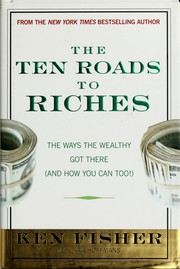
The Ten Roads to Riches
Open Library records first publication as 2009.
Summary
Ken Fisher and Lara Hoffmans examine how large fortunes have actually been made, using the Forbes list of the wealthiest Americans as the data source and classifying its members by route.
The ten roads he identifies are: founding a business, which he argues is the most common and highest-return route; joining an existing business as an employee and rising to senior executive positions with equity; riding along as a partner or early associate of a founder; marrying wealth; inheriting it; suing for it through litigation; capitalising on other people's money as a money manager or financier; inventing income streams through intellectual property and royalties; real estate; and stealing it, which he includes to note that it does not work.
Fisher's method is to count the members of the list by category and to discuss what each route requires. His practical point is that these routes have different characteristics: founding requires capital and tolerance of failure, executive employment requires a long institutional career and produces less, financing other people's money is capital-efficient and requires a track record. He is direct that the founder route dominates by frequency and by magnitude. The book is lighter than his others and the classification is impressionistic rather than rigorous. Its useful function is forcing a reader to be explicit about which route they are actually pursuing.
Key takeaways 7
- Founding a business is the most common route to a large fortune by both frequency and magnitude in the data Fisher examines.
- Rising through an existing company to senior executive positions with equity produces smaller fortunes than founding but requires less capital risk.
- Managing other people's money is capital-efficient because the manager captures a share of returns without supplying the principal.
- Inheritance accounts for a substantial share of the wealthiest list, which the founder narrative usually obscures.
- Each route has different requirements in capital, time horizon and tolerance of failure, and pursuing one while equipped for another fails.
- Fisher argues that most people never become explicit about which route they are actually on.
- The classification is impressionistic rather than rigorous, so the counts should be treated as illustrative.
Who should read it
Founders and professionals thinking explicitly about which wealth-building route they are pursuing and what each actually requires.
About Ken Fisher
Founder and Executive Chairman, Fisher Investments; Forbes "Portfolio Strategy" columnist 1984-2016
A long, public money-management record plus Super Stocks, which introduced the price-to-sales ratio and outlived its news cycle.
Where it sits in the reference 2
Similar books 6
Chosen by shared topics, the entries that hold them, and the people who recommended both.