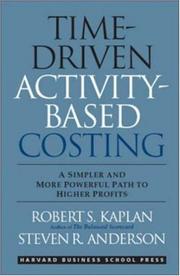
Time-Driven Activity-Based Costing
The simplified successor to ABC, after ABC proved too costly to run.
Summary
Robert Kaplan developed activity-based costing in the 1980s with Robin Cooper, and this book with Steven Anderson revises it in response to the practical failures the original method encountered.
The original approach required identifying the activities a firm performs, estimating the resources each consumes through interviews and surveys of employees, and then assigning activity costs to products and customers through cost drivers. Kaplan concedes that this proved expensive to implement and expensive to maintain, that the employee surveys produced estimates summing to a hundred per cent of time regardless of actual idle capacity, and that models became too complex to update, so most implementations decayed.
The revision simplifies the estimation. Instead of surveying employees, the analyst estimates the practical capacity of each resource group and the unit cost of supplying that capacity, then estimates the time each activity requires. Time equations allow variations, so that an order taking longer because it is a rush order or a foreign customer can be modelled without creating a separate activity. The method produces a cost of unused capacity as an explicit output rather than burying it in product costs, which Kaplan treats as the most important change: unused capacity is a management decision, not a product cost. The book includes implementation cases. The approach remains demanding to implement and the estimates of unit times are as uncertain as any other estimate.
Key takeaways 7
- The original activity-based costing method failed in practice because employee surveys were expensive and models became too complex to maintain.
- Employee time surveys sum to a hundred per cent regardless of actual idle capacity, which buries unused capacity in product costs.
- The revised method estimates the practical capacity and unit cost of each resource group and the time each activity consumes.
- Time equations model variations in a single activity without creating separate activities for each case.
- Unused capacity cost is produced as an explicit output and is a management decision rather than a product cost.
- Costing systems that cannot be updated cheaply decay into irrelevance, which is why simplicity matters more than precision.
- Unit time estimates remain estimates, so the method's precision is bounded by how well those are known.
Who should read it
Controllers and operations managers implementing costing systems who need product and customer profitability without the maintenance burden of the original method.
Where it sits in the reference 2
Similar books 6
Chosen by shared topics, the entries that hold them, and the people who recommended both.