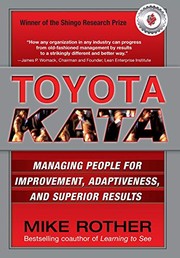
Toyota Kata
The improvement and coaching routines beneath the visible tools.
Summary
Mike Rother spent years studying how Toyota managers actually behave, as distinct from the tools and practices that Western firms had copied, and this book reports what he found. His argument is that the visible elements of the Toyota Production System are outputs of an underlying routine, and that copying the outputs without the routine produces nothing durable.
The routine he identifies has two parts. The improvement kata is a repeating pattern: understand the direction or challenge, grasp the current condition with actual data, establish the next target condition, which is a specific description of how the process should operate by a specific date, and then experiment toward it one step at a time. Each experiment is a prediction tested at what Rother calls the threshold of knowledge, meaning the boundary of what is currently known. The coaching kata is the corresponding routine for managers, who ask a fixed set of five questions of the person doing the improvement rather than solving the problem for them.
Rother's central claim is that Toyota's advantage is that everyone in the organisation practises a scientific routine continuously, and that this is a skill developed through deliberate coaching rather than a set of tools. He argues that Western firms adopted the tools because they were visible and missed the routine because it lives in daily interactions. The book is practical, with the five coaching questions specified exactly, and it has generated a substantial implementation literature. Its evidence is Rother's own observation rather than controlled comparison.
Key takeaways 7
- The visible tools of the Toyota Production System are outputs of an underlying management routine, and copying them alone produces nothing durable.
- The improvement kata proceeds from challenge to current condition to a specific target condition and then to experiments toward it.
- A target condition is a specific description of how a process should operate by a specific date, not a goal or a result.
- Each experiment is a prediction tested at the threshold of what is currently known, so failure produces information rather than embarrassment.
- The coaching kata gives managers a fixed set of five questions to ask rather than problems to solve.
- Rother argues that Toyota's advantage is that everyone practises a scientific routine continuously as a developed skill.
- The evidence is the author's own observation rather than controlled comparison with firms that do not do this.
Who should read it
Operators and managers implementing continuous improvement who want the behavioural routine behind the tools rather than another set of tools.
Where it sits in the reference 2
Similar books 6
Chosen by shared topics, the entries that hold them, and the people who recommended both.