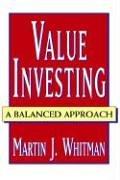
Value Investing: A Balanced Approach
Net asset value and resource conversion as the real drivers of return.
Summary
Whitman ran Third Avenue Value Fund and wrote from the position of a control investor and distressed securities specialist rather than that of a stock picker. His argument is a direct challenge to the Graham and Dodd tradition as commonly practised.
His first claim is that conventional security analysis overweights the income statement. Graham-influenced investors focus on going-concern earnings and dividends, which is the correct frame only for a passive minority investor in an operating business that will continue as it is. Whitman argues that most companies are better analysed through the balance sheet, because assets can be sold, refinanced, spun off or used as collateral, and because the range of outcomes for a company includes takeover, liquidation, recapitalisation and reorganisation as well as continued operation. He calls these outcomes resource conversion and treats them as normal rather than exceptional.
His second claim is that the analyst must know which type of investor they are. An outside passive minority investor faces different information, different rights and different economics from a control investor, and applying the wrong frame produces wrong conclusions. Much of academic finance, in his view, models the first while the actual determinants of value come from the second.
His practical standard is safe and cheap: buy companies with strong financial position, meaning little debt and substantial liquid assets, with honest and competent management, with understandable disclosure, and at a large discount to readily ascertainable net asset value.
The writing is dense and unstructured, and Whitman assumes familiarity with securities law, bankruptcy and accounting. His approach performed poorly in the decade after the financial crisis, when asset-heavy discounted companies stayed discounted, and his dismissal of earnings power looks less persuasive in an economy where the most valuable businesses hold few tangible assets.
Key takeaways 7
- Balance sheet analysis matters more than earnings analysis because assets can be converted through sale, refinancing or reorganisation.
- An investor must first establish whether they are a passive minority holder or a control investor, because the two face different economics entirely.
- Resource conversion events such as takeovers, spin-offs and recapitalisations are normal outcomes rather than exceptions to be excluded from analysis.
- Strong financial position, meaning low debt and substantial liquidity, is the precondition for any value investment because it buys time.
- Academic finance models the passive minority investor and therefore misses where most value is actually created.
- Net asset value that can be readily ascertained is a more reliable anchor than a discounted cash flow projection.
- Bankruptcy reorganisation is a valuation process, and understanding it is part of ordinary security analysis rather than a specialty.
Who should read it
Investors working in distressed debt, control situations or asset-heavy companies who want the balance sheet case against earnings-based value investing.
About Martin J. Whitman
Founder and Chairman, Third Avenue Management; portfolio manager, Third Avenue Value Fund 1990-2012
Four books plus three decades of unusually didactic shareholder letters built out safe-and-cheap and distress investing as a distinct branch of the value tradition.
Where it sits in the reference 2
Who recommended it 1 · 1 direct
Similar books 6
Chosen by shared topics, the entries that hold them, and the people who recommended both.