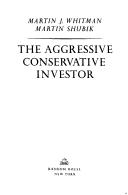
The Aggressive Conservative Investor
Reissued 2006 with a new preface by Whitman.
Summary
Whitman ran Third Avenue Management and wrote with Shubik, an economist, presenting an approach they call safe and cheap investing. Its central claim is that risk and return are not necessarily correlated, and that a security can be both safer and cheaper than the alternatives if the analysis is done properly.
Their method starts from the balance sheet rather than from earnings. They argue that most analysis focuses on the income statement because it is what Wall Street reports on, and that asset values, financial position and the quality of the accounting matter more for determining what a security is worth. Their four criteria for a safe and cheap purchase are a strong financial position, honest and competent management with an ownership interest, an understandable business with reliable disclosure, and a price substantially below net asset value.
Their concept of resource conversion is the distinctive contribution. They argue that value is realised not only through operating earnings but through changes in control, mergers, liquidations, spinoffs, refinancings and other transformations of the corporate structure, and that an investor should analyse a company as a set of assets that could be redeployed rather than as an ongoing operation alone.
They also distinguish outside passive minority investors from control investors, arguing that the two face different information, different risks and different opportunities, and that advice designed for one misleads the other. The reference has verified the framework and the core concepts rather than the detail of every chapter. The book is from 1979, the accounting references are dated, and the writing is dense. The resource conversion framework and the balance sheet emphasis remain the reason practitioners read it.
Key takeaways 8
- Risk and return are not necessarily correlated, and a security can be both safer and cheaper than the alternatives.
- The balance sheet and the quality of the financial position matter more than reported earnings for determining what a security is worth.
- A safe and cheap purchase requires a strong financial position, competent and honest management with ownership, reliable disclosure and a substantial discount to net asset value.
- Value is realised through resource conversion including mergers, liquidations, spinoffs and refinancings as well as through operating earnings.
- A company should be analysed as a set of assets that could be redeployed rather than only as an ongoing operation.
- Outside passive minority investors and control investors face different information and different opportunities, and advice designed for one misleads the other.
- Financial position determines a company's ability to survive adverse conditions, which is the actual source of downside protection.
- Accounting figures must be reconstructed rather than accepted, since disclosure quality varies enormously between companies.
Who should read it
Investors interested in balance sheet analysis and in value realised through corporate transformation rather than through operating performance.
About Martin J. Whitman
Founder and Chairman, Third Avenue Management; portfolio manager, Third Avenue Value Fund 1990-2012
Four books plus three decades of unusually didactic shareholder letters built out safe-and-cheap and distress investing as a distinct branch of the value tradition.
Where it sits in the reference 3
Who recommended it 3 · 2 direct
Similar books 6
Chosen by shared topics, the entries that hold them, and the people who recommended both.